---
createdAt: 2025-01-02
updatedAt: 2026-09-27
priority: 9
title: react-i18next vs react-intl vs Intlayer
description: Integrate react-i18next with next-intl and Intlayer for the internationalization (i18n) of a React app
keywords:
- next-intl
- react-i18next
- Intlayer
- Internationalization
- Blog
- Next.js
- JavaScript
- React
slugs:
- blog
- react-i18next-vs-react-intl-vs-intlayer
author: aymericzip
---
# react-Intl VS react-i18next VS intlayer
This guide compares three established i18n options for **React**: **react-intl** (FormatJS), **react-i18next** (i18next), and **Intlayer**.
We focus on **plain React** applications (e.g., Vite, CRA, SPA). If you’re using Next.js, see our dedicated Next.js comparison.
We evaluate:
- Architecture & content organization
- TypeScript & safety
- Missing translation handling
- Rich content & formatting capabilities
- Performance & loading behavior
- Developer experience (DX), tooling & maintenance
- SEO/routing (framework-dependent)
> **tl;dr**: All three can localize a React app. If you want **component-scoped content**, **strict TypeScript types**, **build-time missing-key checks**, **tree-shaken dictionaries**, and built-in editorial tooling (Visual Editor/CMS + optional AI translation), **Intlayer** is the most complete choice for modular React codebases.
## High-level positioning
- **react-intl** - ICU-first, standards-aligned formatting (dates/numbers/plurals) with a mature API. Catalogs are typically centralized; key safety and build-time validation are largely on you.
- **react-i18next** - Extremely popular and flexible; namespaces, detectors, and many plugins (ICU, backends). Powerful, but configuration can sprawl as projects scale.
- **Intlayer** - Component-centric content model for React, **strict TS typing**, **build-time checks**, **tree-shaking**, plus **Visual Editor/CMS** and **AI-assisted translations**. Works with React Router, Vite, CRA, etc.
> To understand where these libraries come from, read the history of JavaScript i18n.
- [The history of JavaScript i18n](https://github.com/aymericzip/intlayer/blob/main/docs/blog/en/history_of_i18n.md)
## Feature matrix (React focus)
| Feature | `react-intlayer` (Intlayer) | `react-i18next` (i18next) | `react-intl` (FormatJS) |
| --------------------------------------------- | ----------------------------------------------------------------------------------------------------------------------------------- | -------------------------------------------------------------------------------------------------------- | ------------------------------------------------------------------------------------------- |
| **Translations Near Components** | ✅ Yes, content collocated with each component | ❌ No | ❌ No |
| **TypeScript Integration** | ✅ Advanced, auto-generated strict types | ⚠️ Basic; extra config for safety | ✅ Good, but less strict |
| **Missing Translation Detection** | ✅ TypeScript error hightlight and build-time error/warning | ⚠️ Mostly fallback strings at runtime | ⚠️ Fallback strings |
| **Rich Content (JSX/Markdown/components)** | ✅ Direct support | ⚠️ Limited / interpolation only | ⚠️ ICU syntax, not real JSX |
| **AI-powered Translation** | ✅ Yes, supports multiple AI providers. Usable using your own API keys. Considers the context of your application and content scope | ❌ No | ❌ No |
| **Visual Editor** | ✅ Yes, local Visual Editor + optional CMS; can externalize codebase content; embeddable | ❌ No / available via external localization platforms | ❌ No / available via external localization platforms |
| **Localized Routing** | ✅ Yes, supports localized paths out of the box (works with Next.js & Vite) | ⚠️ No built-in, requires plugins (e.g. `next-i18next`) or custom router config | ❌ No, only message formatting, routing must be manual |
| **Dynamic Route Generation** | ✅ Yes | ⚠️ Plugin/ecosystem or manual setup | ❌ Not provided |
| **Pluralization** | ✅ Enumeration-based patterns | ✅ Configurable (plugins like i18next-icu) | ✅ (ICU) |
| **Formatting (dates, numbers, currencies)** | ✅ Optimized formatters (Intl under the hood) | ⚠️ Via plugins or custom Intl usage | ✅ ICU formatters |
| **Content Format** | ✅ .tsx, .ts, .js, .json, .md, .txt, (.yaml WIP) | ⚠️ .json | ✅ .json, .js |
| **ICU support** | ⚠️ WIP | ⚠️ Via plugin (i18next-icu) | ✅ Yes |
| **SEO Helpers (hreflang, sitemap)** | ✅ Built-in tools: helpers for sitemap, robots.txt, metadata | ⚠️ Community plugins/manual | ❌ Not core |
| **Ecosystem / Community** | ⚠️ Smaller but growing fast and reactive | ✅ Largest and mature | ✅ Large |
| **Server-side Rendering & Server Components** | ✅ Yes, streamlined for SSR / React Server Components | ⚠️ Supported at page level but need to pass t-functions on component tree for children server components | ❌ Not supported, need to pass t-functions on component tree for children server components |
| **Tree-shaking (load only used content)** | ✅ Yes, per-component at build time via Babel/SWC plugins | ⚠️ Usually loads all (can be improved with namespaces/code-splitting) | ⚠️ Usually loads all |
| **Lazy loading** | ✅ Yes, per-locale / per-dictionary | ✅ Yes (e.g., backends/namespaces on demand) | ✅ Yes (split locale bundles) |
| **Purge unused content** | ✅ Yes, per-dictionary at build time | ❌ No, only via manual namespace segmentation | ❌ No, all declared messages are bundled |
| **Management of Large Projects** | ✅ Encourages modular, suited for design-system | ⚠️ Needs good file discipline | ⚠️ Central catalogs can get large |
## Deep-dive comparison
### 1) Architecture & scalability
- **react-intl / react-i18next**: Most setups maintain **centralized locale folders** per language, sometimes split by **namespaces** (i18next). Works well early on but becomes a shared surface area as apps grow.
- **Intlayer**: Promotes **per-component (or per-feature) dictionaries** **co-located** with the UI they serve. This keeps ownership clear, eases duplication/migration of components, and reduces cross-team key churn. Unused content is easier to identify and remove.
**Why it matters:** Modular content mirrors modular UI. Large React codebases stay cleaner when translations live with the components they belong to.
### 2) TypeScript & safety
- **react-intl**: Solid typings, but **no automatic key typing**; you enforce safety patterns yourself.
- **react-i18next**: Strong typings for hooks; **strict key typing** typically requires extra configuration or generators.
- **Intlayer**: **Auto-generates strict types** from your content. IDE autocomplete and **compile-time errors** catch typos and missing keys before runtime.
**Why it matters:** Shifting failures **left** (to build/CI) reduces production issues and speeds developer feedback loops.
### 3) Missing translation handling
- **react-intl / react-i18next**: Default to **runtime fallbacks** (key echo or default locale). You can add linting/plugins, but it’s not guaranteed at build.
- **Intlayer**: **Build-time detection** with warnings or errors when required locales/keys are missing.
**Why it matters:** CI failing on missing strings prevents “mystery English” leaking into non-English UIs.
### 4) Rich content & formatting
- **react-intl**: Excellent **ICU** support for plurals, selects, dates/numbers, and message composition. JSX can be used, but the mental model stays message-centric.
- **react-i18next**: Flexible interpolation and **``** for embedding elements/components; ICU available via plugin.
- **Intlayer**: Content files can include **rich nodes** (JSX/Markdown/components) and **metadata**. Formatting uses Intl under the hood; plural patterns are ergonomic.
**Why it matters:** Complex UI texts (links, bold pieces, inline components) are easier when the library embraces React nodes cleanly.
### 5) Performance & loading behavior
- **react-intl / react-i18next**: You typically manage **catalog splitting** and **lazy loading** manually (namespaces/dynamic imports). Effective but requires discipline.
- **Intlayer**: **Tree-shakes** unused dictionaries and supports **per-dictionary/per-locale lazy loading** out-of-the-box.
**Why it matters:** Smaller bundles and fewer unused strings improve startup and navigation performance.
The graph below estimates the payload for a theoretical app of 1 to 10 pages in 1 to 10 locales, with about 30 KB of text per page. Lazy loading per locale removes the locale axis, scoping content per component removes the page axis, and only the combination stays flat.

#### Benchmark results on React (TanStack Start / Vite)
Numbers from [Benchmark Bloom](https://github.com/intlayer-org/benchmark-bloom) measuring standard React implementations on TanStack Start:
| Library | Strategy | Lib size (gz) | Page JS avg (gz) | Locale leak | Page leak | Component avg (gz) | E2E reactivity | Hydration |
| ------------------ | -------- | ------------: | ---------------: | ----------: | --------: | -----------------: | -------------: | --------: |
| **base** (no i18n) | - | 0.0 KB | 111.0 KB | 0.0% | 0.0% | 0.7 KB | 8.1 ms | 21.6 ms |
| `react-i18next` | dynamic | 18.4 KB | 136.4 KB | 23.1% | 89.8% | 24.8 KB | 123.1 ms | 32.9 ms |
| **`intlayer`** | dynamic | **5.0 KB** | **118.6 KB** | **0.0%** | **0.0%** | **6.3 KB** | **3.6 ms** | 14.1 ms |
> Full table in the [TanStack Start benchmark report](https://github.com/aymericzip/intlayer/blob/main/docs/docs/en/benchmark/tanstack.md) and [i18n Benchmark Overview](https://github.com/aymericzip/intlayer/blob/main/docs/docs/en/benchmark/index.md).
- [TanStack Start benchmark report](https://github.com/aymericzip/intlayer/blob/main/docs/docs/en/benchmark/tanstack.md)
- [i18n Benchmark Overview](https://github.com/aymericzip/intlayer/blob/main/docs/docs/en/benchmark/index.md)
### 6) DX, tooling & maintenance
- **react-intl / react-i18next**: Broad community ecosystem; for editorial workflows you usually adopt external localization platforms.
- **Intlayer**: Ships a **free Visual Editor** and **optional CMS** (keep content in Git or externalize it). Also offers a **VSCode extension** for content authoring and **AI-assisted translation** using your own provider keys.
**Why it matters:** Built-in tooling shortens the loop between developers and content authors - less glue code, fewer vendor dependencies.
## When to choose which?
- **Choose react-intl** if you want **ICU-first** message formatting with a straightforward, standards-aligned API and your team is comfortable maintaining catalogs and safety checks manually.
- **Choose react-i18next** if you need the **breadth of i18next’s ecosystem** (detectors, backends, ICU plugin, integrations) and accept more configuration to gain flexibility.
- **Choose Intlayer** if you value **component-scoped content**, **strict TypeScript**, **build-time guarantees**, **tree-shaking**, and **batteries-included** editorial tooling - especially for **large, modular** React apps, design-systems, etc.
## Interoperability with `react-intl` and `react-i18next`
`intlayer` can also help to manage your `react-intl` and `react-i18next` namespaces.
Using `intlayer`, you can declare your content in the format of your favorite i18n library, and intlayer will generate your namespaces in the location of your choice (example: `/messages/{{locale}}/{{namespace}}.json`).
## Further reading & benchmarks
- [i18next vs @intlayer/i18next](https://github.com/aymericzip/intlayer/blob/main/docs/blog/en/i18next_vs_intlayer-i18next.md)
- [next-intl vs Intlayer](https://github.com/aymericzip/intlayer/blob/main/docs/blog/en/next-intl_vs_intlayer.md)
- [Bundle optimization](https://github.com/aymericzip/intlayer/blob/main/docs/docs/en/bundle_optimization.md)
- [the Intlayer compiler](https://github.com/aymericzip/intlayer/blob/main/docs/docs/en/compiler.md)
Benchmark reports:
- [i18n Benchmark Overview](https://github.com/aymericzip/intlayer/blob/main/docs/docs/en/benchmark/index.md)
- [TanStack Start](https://github.com/aymericzip/intlayer/blob/main/docs/docs/en/benchmark/tanstack.md)
- [Next.js](https://github.com/aymericzip/intlayer/blob/main/docs/docs/en/benchmark/nextjs.md)
- [Vue](https://github.com/aymericzip/intlayer/blob/main/docs/docs/en/benchmark/vue.md)
- [Solid](https://github.com/aymericzip/intlayer/blob/main/docs/docs/en/benchmark/solid.md)
- [Svelte](https://github.com/aymericzip/intlayer/blob/main/docs/docs/en/benchmark/svelte.md)
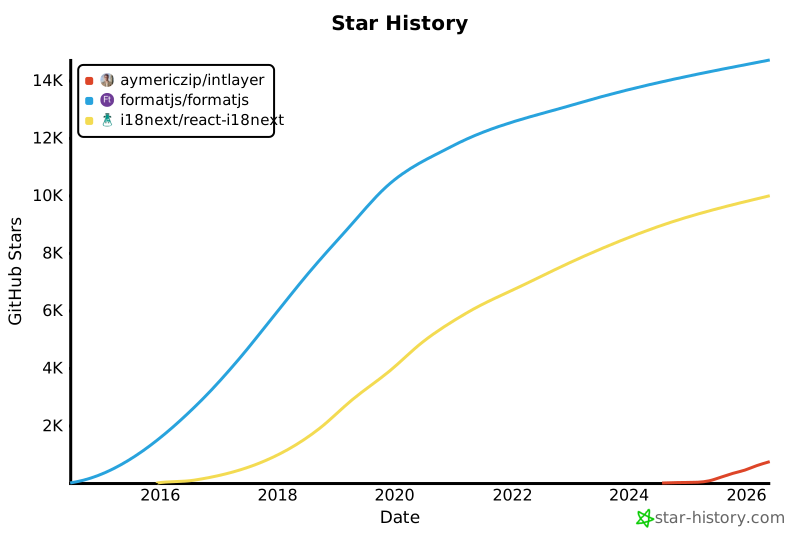
## GitHub STARs
GitHub stars are a strong indicator of a project's popularity, community trust, and long-term relevance. While not a direct measure of technical quality, they reflect how many developers find the project useful, follow its progress, and are likely to adopt it. For estimating the value of a project, stars help compare traction across alternatives and provide insights into ecosystem growth.
[](https://star-history.com/#formatjs/formatjs&i18next/react-i18next&aymericzip/intlayer)
## Commit activity
Stars show popularity. Commits show how much work goes into a project. At the time of writing, Intlayer counts about 7,500 commits, more than most libraries compared here, and about 5 times more than `next-intl` or `next-i18next`.
> Intlayer is a monorepo, so its count includes every framework package, the CLI and the docs. Read commits as a signal of activity, not of quality.
## npm downloads
Downloads reward the oldest solutions, not the best ones. A library released years ago is still installed by every project that picked it back then, by every CI run and by every package that depends on it. The count measures inertia more than a fresh choice.
AI assistants amplify the effect. `next-intl`, `i18next` and `vue-i18n` are everywhere in the code they were trained on, so they suggest them by default, without comparing the alternatives. Each suggestion adds downloads, which feeds the next suggestion. Compare on the benchmark rather than on the download count.
## Conclusion
All three libraries localize React effectively. The differentiator is how much **infrastructure** you must build to reach a **safe, scalable** setup:
- With **Intlayer**, **modular content**, **strict TS typing**, **build-time safety**, **tree-shaken bundles**, and **editorial tooling** are defaults - not chores.
- If your team prizes **maintainability and speed** in multi-locale, component-driven React apps, Intlayer offers the **most complete** developer and content workflow today.
Refer to ['Why Intlayer?' doc](https://github.com/aymericzip/intlayer/blob/main/docs/docs/en/interest_of_intlayer.md) for more details.
- [Why Intlayer? Benefits over Other i18n Libraries](https://github.com/aymericzip/intlayer/blob/main/docs/docs/en/interest_of_intlayer.md)