---
createdAt: 2025-04-18
updatedAt: 2025-12-30
title: Analog i18n - How to translate your Analog app – guide 2026
description: Discover how to make your Analog app multilingual. Follow the documentation to internationalize (i18n) and translate it.
keywords:
- Internationalization
- Documentation
- Intlayer
- Analog
- Angular
- JavaScript
slugs:
- doc
- environment
- analog
applicationTemplate: https://github.com/aymericzip/intlayer/tree/main/examples/analog-app-template
history:
- version: 8.0.4
date: 2026-01-26
changes: Init history
---
# Translate your Analog (Angular) app using Intlayer | Internationalization (i18n)
## Table of Contents
## What is Intlayer?
**Intlayer** is an innovative, open-source internationalization (i18n) library designed to simplify multilingual support in modern web applications.
With Intlayer, you can:
- **Easily manage translations** using declarative dictionaries at the component level.
- **Dynamically localize metadata**, routes, and content.
- **Ensure TypeScript support** with autogenerated types, improving autocompletion and error detection.
- **Benefit from advanced features**, like dynamic locale detection and switching.
---
## Step-by-Step Guide to Set Up Intlayer in an Analog Application
See [Application Template](https://github.com/aymericzip/intlayer/tree/main/examples/analog-app-template) on GitHub.
### Step 1: Install Dependencies
Install the necessary packages using npm:
```bash packageManager="npm"
npm install intlayer angular-intlayer vite-intlayer
npx intlayer init
```
```bash packageManager="pnpm"
pnpm add intlayer angular-intlayer vite-intlayer
pnpm intlayer init
```
```bash packageManager="yarn"
yarn add intlayer angular-intlayer vite-intlayer
yarn intlayer init
```
```bash packageManager="bun"
bun add intlayer angular-intlayer vite-intlayer
bunx intlayer init
```
- **intlayer**
The core package that provides internationalization tools for configuration management, translation, [content declaration](https://github.com/aymericzip/intlayer/blob/main/docs/docs/en/dictionary/content_file.md), transpilation, and [CLI commands](https://github.com/aymericzip/intlayer/blob/main/docs/docs/en/cli/index.md).
- **angular-intlayer**
The package that integrates Intlayer with Angular application. It provides context providers and hooks for Angular internationalization.
- **vite-intlayer**
The package that integrates Intlayer with Vite. It provides a plugin to handle content declaration files and sets up aliases for optimal performance.
### Step 2: Configuration of your project
Create a config file to configure the languages of your application:
```typescript fileName="intlayer.config.ts" codeFormat="typescript"
import { Locales, type IntlayerConfig } from "intlayer";
const config: IntlayerConfig = {
internationalization: {
locales: [
Locales.ENGLISH,
Locales.FRENCH,
Locales.SPANISH,
// Your other locales
],
defaultLocale: Locales.ENGLISH,
},
};
export default config;
```
```javascript fileName="intlayer.config.mjs" codeFormat="esm"
import { Locales } from "intlayer";
/** @type {import('intlayer').IntlayerConfig} */
const config = {
internationalization: {
locales: [
Locales.ENGLISH,
Locales.FRENCH,
Locales.SPANISH,
// Your other locales
],
defaultLocale: Locales.ENGLISH,
},
};
export default config;
```
```javascript fileName="intlayer.config.cjs" codeFormat="commonjs"
const { Locales } = require("intlayer");
/** @type {import('intlayer').IntlayerConfig} */
const config = {
internationalization: {
locales: [
Locales.ENGLISH,
Locales.FRENCH,
Locales.SPANISH,
// Your other locales
],
defaultLocale: Locales.ENGLISH,
},
};
module.exports = config;
```
> Through this configuration file, you can set up localized URLs, middleware redirection, cookie names, the location and extension of your content declarations, disable Intlayer logs in the console, and more. For a complete list of available parameters, refer to the [configuration documentation](https://github.com/aymericzip/intlayer/blob/main/docs/docs/en/configuration.md).
### Step 3: Integrate Intlayer in Your Vite Configuration
To integrate Intlayer with Analog, you need to use the `vite-intlayer` plugin.
Modify your `vite.config.ts` file:
```typescript fileName="vite.config.ts"
import { defineConfig } from "vite";
import { intlayer } from "vite-intlayer";
import analog from "@analogjs/platform";
// https://vitejs.dev/config/
export default defineConfig(() => ({
plugins: [
analog(),
intlayer(), // Add the Intlayer plugin
],
}));
```
> The `intlayer()` plugin configures Vite with Intlayer. It handles content declaration files and sets up aliases for optimal performance.
### Step 4: Declare Your Content
Create and manage your content declarations to store translations:
```tsx fileName="src/app/app.content.ts" contentDeclarationFormat="typescript"
import { t, type Dictionary } from "intlayer";
const appContent = {
key: "app",
content: {
title: t({
en: "Hello",
fr: "Bonjour",
es: "Hola",
}),
congratulations: t({
en: "Congratulations! Your app is running. 🎉",
fr: "Félicitations! Votre application est en cours d'exécution. 🎉",
es: "¡Felicidades! Tu aplicación está en ejecución. 🎉",
}),
},
} satisfies Dictionary;
export default appContent;
```
> Your content declarations can be defined anywhere in your application as soon they are included into the `contentDir` directory (by default, `./src`). And match the content declaration file extension (by default, `.content.{json,ts,tsx,js,jsx,mjs,cjs}`).
> For more details, refer to the [content declaration documentation](https://github.com/aymericzip/intlayer/blob/main/docs/docs/en/dictionary/content_file.md).
### Step 5: Utilize Intlayer in Your Code
To utilize Intlayer's internationalization features throughout your Analog application, you need to provide Intlayer in your application configuration.
```typescript fileName="src/app/app.config.ts"
import { ApplicationConfig } from "@angular/core";
import { provideIntlayer } from "angular-intlayer";
export const appConfig: ApplicationConfig = {
providers: [
provideIntlayer(), // Add the Intlayer provider here
],
};
```
Then, you can use the `useIntlayer` function within any component.
```typescript fileName="src/app/pages/index.page.ts"
import { Component } from "@angular/core";
import { useIntlayer } from "angular-intlayer";
@Component({
selector: "app-home",
standalone: true,
template: `
{{ content().title }}
{{ content().congratulations }}
`,
})
export default class HomeComponent {
content = useIntlayer("app");
}
```
Intlayer content is returned as a `Signal`, so you access the values by calling the signal: `content().title`.
### (Optional) Step 6: Change the language of your content
To change the language of your content, you can use the `setLocale` function provided by the `useLocale` function. This allows you to set the locale of the application and update the content accordingly.
Create a component to switch between languages:
```typescript fileName="src/app/locale-switcher.component.ts"
import { Component } from "@angular/core";
import { CommonModule } from "@angular/common";
import { useLocale } from "angular-intlayer";
@Component({
selector: "app-locale-switcher",
standalone: true,
imports: [CommonModule],
template: `
`,
styles: [
`
.locale-switcher {
margin: 1rem;
padding: 0.5rem;
border: 1px solid #ccc;
border-radius: 4px;
width: fit-content;
}
`,
],
})
export class LocaleSwitcherComponent {
localeCtx = useLocale();
locale = this.localeCtx.locale;
availableLocales = this.localeCtx.availableLocales;
setLocale = this.localeCtx.setLocale;
}
```
Then, use this component in your pages:
```typescript fileName="src/app/pages/index.page.ts"
import { Component } from "@angular/core";
import { useIntlayer } from "angular-intlayer";
import { LocaleSwitcherComponent } from "../locale-switcher.component";
@Component({
selector: "app-home",
standalone: true,
imports: [LocaleSwitcherComponent],
template: `
{{ content().title }}
{{ content().congratulations }}
`,
})
export default class HomeComponent {
content = useIntlayer("app");
}
```
### Configure TypeScript
Intlayer uses module augmentation to get benefits of TypeScript and make your codebase stronger.
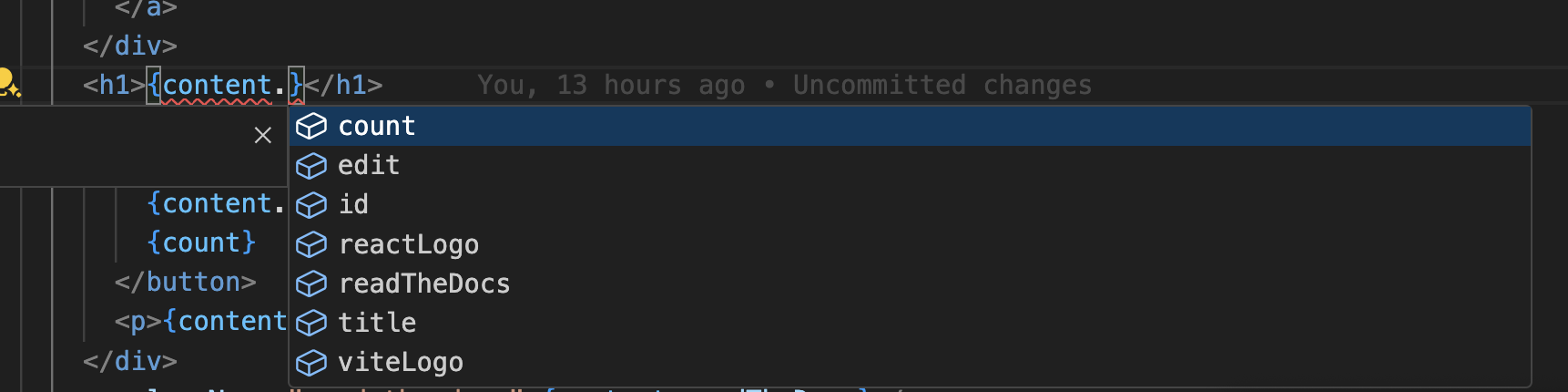
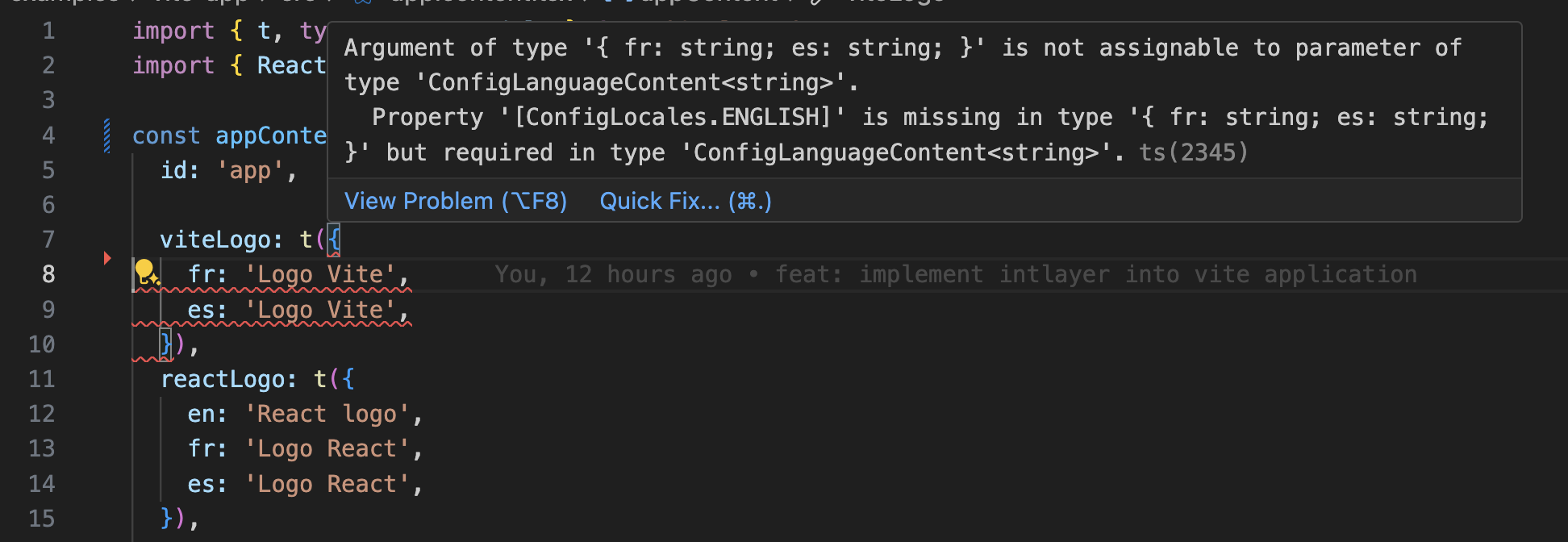
Ensure your TypeScript configuration includes the autogenerated types.
```json5 fileName="tsconfig.json"
{
// ... Your existing TypeScript configurations
"include": [
// ... Your existing TypeScript configurations
".intlayer/**/*.ts", // Include the auto-generated types
],
}
```
### Git Configuration
It is recommended to ignore the files generated by Intlayer. This allows you to avoid committing them to your Git repository.
To do this, you can add the following instructions to your `.gitignore` file:
```plaintext
# Ignore the files generated by Intlayer
.intlayer
```
### VS Code Extension
To improve your development experience with Intlayer, you can install the official **Intlayer VS Code Extension**.
[Install from the VS Code Marketplace](https://marketplace.visualstudio.com/items?itemName=intlayer.intlayer-vs-code-extension)
This extension provides:
- **Autocompletion** for translation keys.
- **Real-time error detection** for missing translations.
- **Inline previews** of translated content.
- **Quick actions** to easily create and update translations.
For more details on how to use the extension, refer to the [Intlayer VS Code Extension documentation](https://intlayer.org/doc/vs-code-extension).
---
### Go Further
To go further, you can implement the [visual editor](https://github.com/aymericzip/intlayer/blob/main/docs/docs/en/intlayer_visual_editor.md) or externalize your content using the [CMS](https://github.com/aymericzip/intlayer/blob/main/docs/docs/en/intlayer_CMS.md).