---
createdAt: 2026-04-24
updatedAt: 2026-09-27
priority: 9
title: "Astro + Vue i18n - Complete guide to translate your app"
description: "Set up Intlayer in Astro with Vue islands: translated components, localized routes and hreflang, with typed per-component content."
keywords:
- Internationalization
- Documentation
- Intlayer
- Astro
- Vue
- i18n
- JavaScript
slugs:
- doc
- environment
- astro
- vue
applicationTemplate: https://github.com/aymericzip/intlayer-astro-template
applicationShowcase: https://intlayer-astro-template.vercel.app
history:
- version: 9.5.5
date: 2026-09-19
changes: "Use the useIntlayer / useLocale hooks of astro-intlayer in the Astro page"
- version: 8.9.0
date: 2026-05-04
changes: "Update Solid useIntlayer API usage to direct property access"
- version: 8.7.7
date: 2026-04-24
changes: "Initial documentation for Astro + Vue"
author: aymericzip
---
# Translate your Astro + Vue website using Intlayer
## Table of Contents
## Why Intlayer over alternatives?
Compared to main solutions like `astro-i18n` or `i18next`, Intlayer is a solution that comes with integrated optimizations such as:
Intlayer is optimized to work perfectly with Astro by offering **multilingual routing**, **sitemap**, and all the features needed for scaling internationalization (i18n).
Instead of loading massive JSON files into your pages, load only the necessary content. Intlayer helps **reduce your bundle and page sizes by up to 50%**.
Scoping your application's content **facilitates maintenance** for large-scale applications. You can duplicate or delete a single feature folder without the mental burden of reviewing your entire content codebase. Additionally, Intlayer is **fully typed** to ensure your content's accuracy.
Co-locating content **reduces the context needed** by Large Language Models (LLMs). Intlayer also comes with a suite of tools, such as a **CLI** to test for missing translations,**[LSP](https://github.com/aymericzip/intlayer/blob/main/docs/docs/en/lsp.md)**, **[MCP](https://github.com/aymericzip/intlayer/blob/main/docs/docs/en/mcp_server.md)**, and **[agent skills](https://github.com/aymericzip/intlayer/blob/main/docs/docs/en/agent_skills.md)**, to make the developer experience (DX) even smoother for AI agents.
- [LSP](https://github.com/aymericzip/intlayer/blob/main/docs/docs/en/lsp.md)
- [MCP](https://github.com/aymericzip/intlayer/blob/main/docs/docs/en/mcp_server.md)
- [agent skills](https://github.com/aymericzip/intlayer/blob/main/docs/docs/en/agent_skills.md)
Use automation to translate in your CI/CD pipeline using the LLM of your choice at the cost of your AI provider. Intlayer also offers a **compiler** to automate content extraction, as well as a [web platform](https://github.com/aymericzip/intlayer/blob/main/docs/docs/en/intlayer_CMS.md) to help **translate in the background**.
- [web platform](https://github.com/aymericzip/intlayer/blob/main/docs/docs/en/intlayer_CMS.md)
Connecting massive JSON files to components can lead to performance and reactivity issues. Intlayer optimizes your content loading at build time.
More than just an i18n solution, Intlayer provides an **self-hosted [visual editor](https://github.com/aymericzip/intlayer/blob/main/docs/docs/en/intlayer_visual_editor.md)** and a **[full CMS](https://github.com/aymericzip/intlayer/blob/main/docs/docs/en/intlayer_CMS.md)** to help you manage your multilingual content in **real-time**, making collaboration with translators, copywriters, and other team members seamless. Content can be stored locally and/or remotely.
- [visual editor](https://github.com/aymericzip/intlayer/blob/main/docs/docs/en/intlayer_visual_editor.md)
- [full CMS](https://github.com/aymericzip/intlayer/blob/main/docs/docs/en/intlayer_CMS.md)
## Step-by-Step Guide to Set Up Intlayer in Astro + Vue
See [Application Template](https://github.com/aymericzip/intlayer-astro-template) on GitHub.
Install the necessary packages using your package manager:
```bash packageManager="npm"
npx intlayer init --interactive
```
```bash packageManager="pnpm"
pnpm dlx intlayer init --interactive
```
```bash packageManager="yarn"
yarn dlx intlayer init --interactive
```
```bash packageManager="bun"
bunx intlayer init --interactive
```
> the `--interactive` flag is optional. Use `intlayer-cli init` if you're an AI agent.
> This command will detect your environment and install the required packages. For example:
```bash packageManager="npm"
npm install intlayer astro-intlayer vue vue-intlayer @astrojs/vue
```
```bash packageManager="pnpm"
pnpm add intlayer astro-intlayer vue vue-intlayer @astrojs/vue
```
```bash packageManager="yarn"
yarn add intlayer astro-intlayer vue vue-intlayer @astrojs/vue
```
```bash packageManager="bun"
bun add intlayer astro-intlayer vue vue-intlayer @astrojs/vue
```
- **intlayer**
The core package that provides internationalization tools for configuration management, translation, [content declaration](https://github.com/aymericzip/intlayer/blob/main/docs/docs/en/dictionary/content_file.md), transpilation, and [CLI commands](https://github.com/aymericzip/intlayer/blob/main/docs/docs/en/cli/index.md).
- **astro-intlayer**
Includes the Astro integration plugin for integrating Intlayer with the [Vite bundler](https://vite.dev/guide/why.html#why-bundle-for-production), a middleware that resolves the locale of every request into `Astro.locals.intlayer`, and the `useIntlayer` / `useDictionary` / `useLocale` hooks. The same import path resolves to the server implementation in your `.astro` frontmatter and to the client one (backed by `vanilla-intlayer`) in `
{{ title }}
Switch locale:
```
> The `locale` prop is passed from the Astro page (server-detected) and used to initialise `installIntlayer`, which makes it the initial locale for all composables in the component tree.
The locale switcher is embedded directly in the Vue island template (shown in Step 6). It uses `useLocale` from `vue-intlayer` and navigates to the localized URL when the user picks a new language:
```vue fileName="src/components/vue/VueIsland.vue"
Switch locale:
```
> **Note on Persistence:**
> Using `onLocaleChange` to redirect via `window.location.href` ensures that the new locale URL is visited, allowing Intlayer middleware to set the locale cookie and remember the user's preference on future visits.
Intlayer provides utilities to generate localized sitemaps and robots.txt files dynamically.
#### Sitemap
Intlayer comes with a built-in sitemap generator to help you create a sitemap for your application easily. It handles localized routes and adds the necessary metadata for search engines.
> The Intlayer generated sitemap supports the `xhtml:link` namespace (Hreflang XML Extensions). Unlike the default sitemap generators that only list raw URLs, Intlayer automatically creates the required bidirectional links between all language versions of a page (e.g., `/about`, `/about?lang=fr`, and `/about?lang=es`). This ensures search engines correctly index and serve the right language version to the right audience.
Create `src/pages/sitemap.xml.ts` to generate a sitemap that includes all your localized routes.
```typescript fileName="src/pages/sitemap.xml.ts"
import type { APIRoute } from "astro";
import { generateSitemap, type SitemapUrlEntry } from "intlayer";
const pathList: SitemapUrlEntry[] = [
{ path: "/", changefreq: "daily", priority: 1.0 },
{ path: "/about", changefreq: "monthly", priority: 0.7 },
];
export const GET: APIRoute = async ({ site }) => {
const xmlOutput = generateSitemap(pathList, {
siteUrl: "https://example.com",
});
return new Response(xmlOutput, {
headers: { "Content-Type": "application/xml" },
});
};
```
#### Robots.txt
Create `src/pages/robots.txt.ts` to control search engine crawling.
```typescript fileName="src/pages/robots.txt.ts"
import type { APIRoute } from "astro";
import { getMultilingualUrls } from "intlayer";
const getAllMultilingualUrls = (urls: string[]) =>
urls.flatMap((url) => Object.values(getMultilingualUrls(url)) as string[]);
const disallowedPaths = getAllMultilingualUrls(["/admin", "/private"]);
export const GET: APIRoute = ({ site }) => {
const robotsTxt = [
"User-agent: *",
"Allow: /",
...disallowedPaths.map((path) => `Disallow: ${path}`),
"",
`Sitemap: ${new URL("/sitemap.xml", site).href}`,
].join("\n");
return new Response(robotsTxt, {
headers: { "Content-Type": "text/plain" },
});
};
```
If you have an existing codebase, transforming thousands of files can be time-consuming.
To ease this process, Intlayer propose a [compiler](https://github.com/aymericzip/intlayer/blob/main/docs/docs/en/compiler.md) / [extractor](https://github.com/aymericzip/intlayer/blob/main/docs/docs/en/cli/extract.md) to transform your components and extract the content.
- [compiler](https://github.com/aymericzip/intlayer/blob/main/docs/docs/en/compiler.md)
- [extractor](https://github.com/aymericzip/intlayer/blob/main/docs/docs/en/cli/extract.md)
To set it up, you can add a `compiler` section in your `intlayer.config.ts` file:
```typescript fileName="intlayer.config.ts" codeFormat={["typescript", "esm", "commonjs"]}
import { type IntlayerConfig } from "intlayer";
const config: IntlayerConfig = {
// ... Rest of your config
compiler: {
/**
* Indicates if the compiler should be enabled.
*/
enabled: true,
/**
* Defines the output files path
*/
output: ({ fileName, extension }) => `./${fileName}${extension}`,
/**
* Indicates if the components should be saved after being transformed.
*
* - If `true`, the compiler will rewrite the component file in the disk. So the transformation will be permanent, and the compiler will skip the transformation for the next process. That way, the compiler can transform the app, and then it can be removed.
*
* - If `false`, the compiler will inject the `useIntlayer()` function call into the code in the build output only, and keep the base codebase intact. The transformation will be done only in memory.
*/
saveComponents: false,
/**
* Dictionary key prefix
*/
dictionaryKeyPrefix: "",
},
};
export default config;
```
Run the extractor to transform your components and extract the content
```bash packageManager="npm"
npx intlayer extract
```
```bash packageManager="pnpm"
pnpm intlayer extract
```
```bash packageManager="yarn"
yarn intlayer extract
```
```bash packageManager="bun"
bun x intlayer extract
```
Build your application to transform your components and extract the content
```bash packageManager="npm"
npm run build # Or npm run dev
```
```bash packageManager="pnpm"
pnpm run build # Or pnpm run dev
```
```bash packageManager="yarn"
yarn build # Or yarn dev
```
```bash packageManager="bun"
bun run build # Or bun run dev
```
### Configure TypeScript
Intlayer use module augmentation to get benefits of TypeScript and make your codebase stronger.

Ensure your TypeScript configuration includes the autogenerated types.
```json5 fileName="tsconfig.json"
{
// ... Your existing TypeScript configurations
include: [
// ... Your existing TypeScript configurations
".intlayer/**/*.ts", // Include the auto-generated types
],
}
```
### Git Configuration
It is recommended to ignore the files generated by Intlayer. This allows you to avoid committing them to your Git repository.
To do this, you can add the following instructions to your `.gitignore` file:
```bash
# Ignore the files generated by Intlayer
.intlayer
```
### VS Code Extension
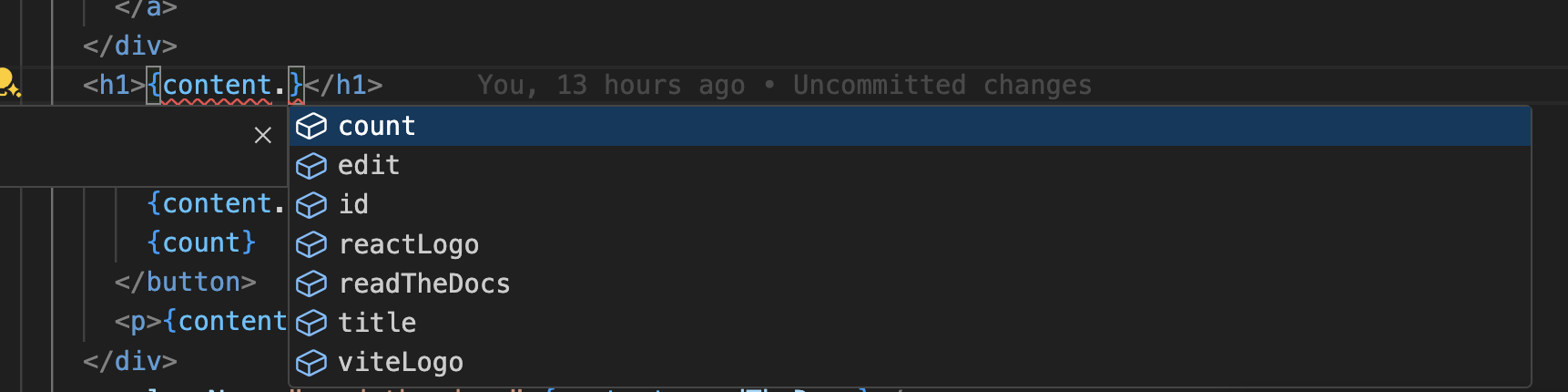
To improve your development experience with Intlayer, you can install the official **Intlayer VS Code Extension**.
- [Install from the VS Code Marketplace](https://marketplace.visualstudio.com/items?itemName=intlayer.intlayer-vs-code-extension)
This extension provides:
- **Autocompletion** for translation keys.
- **Real-time error detection** for missing translations.
- **Inline previews** of translated content.
- **Quick actions** to easily create and update translations.
For more details on how to use the extension, refer to the [Intlayer VS Code Extension documentation](https://github.com/aymericzip/intlayer/blob/main/docs/docs/en/vs_code_extension.md).
- [Intlayer VS Code Extension documentation](https://github.com/aymericzip/intlayer/blob/main/docs/docs/en/vs_code_extension.md)
### Go Further
To go further, you can implement the [visual editor](https://github.com/aymericzip/intlayer/blob/main/docs/docs/en/intlayer_visual_editor.md) or externalize your content using the [CMS](https://github.com/aymericzip/intlayer/blob/main/docs/docs/en/intlayer_CMS.md).
- [visual editor](https://github.com/aymericzip/intlayer/blob/main/docs/docs/en/intlayer_visual_editor.md)
- [CMS](https://github.com/aymericzip/intlayer/blob/main/docs/docs/en/intlayer_CMS.md)
## Frequently Asked Questions
Astro's built-in `i18n` option handles locale prefixes and redirects but not the content itself, so you still need a message layer, and an island adds a second problem: the island runs Vue, not Astro.
- **Astro `i18n` plus hand written dictionaries**, with **`vue-i18n`** inside the island: two content sources to keep in sync, and no shared typing between them.
- **`Intlayer`**: one content layer for both. `astro-intlayer` covers the `.astro` pages and `vue-intlayer` covers the Vue islands, reading the same declarations.
Declaring a label once and using it in both a static page and an interactive island is the reason to pick a single content layer here. See [why Intlayer](https://github.com/aymericzip/intlayer/blob/main/docs/docs/en/interest_of_intlayer.md).
- [why Intlayer](https://github.com/aymericzip/intlayer/blob/main/docs/docs/en/interest_of_intlayer.md)
Much less than a namespace based setup, because a page never downloads a catalog it does not render. Astro pages are rendered at build time, so they ship translated HTML and no dictionary at all; only the islands receive one. The build time compiler resolves the content calls to the exact entries a component uses, and [dynamic dictionaries](https://github.com/aymericzip/intlayer/blob/main/docs/docs/en/dynamic_dictionaries/index.md) split the rest per locale. Measured against the usual alternatives, Intlayer reduces bundle and page size by up to 50%. See [bundle optimization](https://github.com/aymericzip/intlayer/blob/main/docs/docs/en/bundle_optimization.md) and the [benchmark](https://github.com/aymericzip/intlayer/blob/main/docs/docs/en/benchmark/index.md).
- [dynamic dictionaries](https://github.com/aymericzip/intlayer/blob/main/docs/docs/en/dynamic_dictionaries/index.md)
- [bundle optimization](https://github.com/aymericzip/intlayer/blob/main/docs/docs/en/bundle_optimization.md)
- [benchmark](https://github.com/aymericzip/intlayer/blob/main/docs/docs/en/benchmark/index.md)
Largely. Follow the [vue-i18n migration guide](https://github.com/aymericzip/intlayer/blob/main/docs/docs/en/migration_from_vue-i18n_to_intlayer.md) to move the content over. You can also migrate gradually: the [sync JSON plugin](https://github.com/aymericzip/intlayer/blob/main/docs/docs/en/plugins/sync-json.md) keeps your existing JSON catalogs as the source of truth and generates Intlayer dictionaries from them, so both layers stay in sync while you move components across one at a time.
- [vue-i18n migration guide](https://github.com/aymericzip/intlayer/blob/main/docs/docs/en/migration_from_vue-i18n_to_intlayer.md)
- [sync JSON plugin](https://github.com/aymericzip/intlayer/blob/main/docs/docs/en/plugins/sync-json.md)
Yes. The [sync JSON plugin](https://github.com/aymericzip/intlayer/blob/main/docs/docs/en/plugins/sync-json.md) keeps your `/messages/{locale}/{namespace}.json` files as the source of truth and generates Intlayer dictionaries from them, in both directions. A [sync PO plugin](https://github.com/aymericzip/intlayer/blob/main/docs/docs/en/plugins/sync-po.md) does the same for gettext catalogs, and [per locale files](https://github.com/aymericzip/intlayer/blob/main/docs/docs/en/per_locale_file.md) let you split content by language instead of grouping locales in one file.
- [sync JSON plugin](https://github.com/aymericzip/intlayer/blob/main/docs/docs/en/plugins/sync-json.md)
- [sync PO plugin](https://github.com/aymericzip/intlayer/blob/main/docs/docs/en/plugins/sync-po.md)
- [per locale files](https://github.com/aymericzip/intlayer/blob/main/docs/docs/en/per_locale_file.md)
No. Run `npx intlayer extract` and Intlayer reads your components, pulls the user facing strings out and writes a `.content` file next to each one, so you review a diff instead of copying strings into a catalog one at a time. Step 15 of this guide walks through it.
For a fully automated pipeline, the [Intlayer Compiler](https://github.com/aymericzip/intlayer/blob/main/docs/docs/en/compiler.md) does the same at build time: it scans your JSX, TSX, Vue and Svelte source on every change, generates the dictionaries and keeps them in sync through hot module replacement, so there are no keys to maintain by hand at all.
- [Intlayer Compiler](https://github.com/aymericzip/intlayer/blob/main/docs/docs/en/compiler.md)
Two limits are worth knowing before you turn the compiler on. It works by static analysis, so strings that only exist at runtime, such as API error codes or CMS fields, stay out of reach. And it has to tell user facing text apart from application logic like `className="active"` or a status code, which needs a few annotations in a large codebase. The [extract command](https://github.com/aymericzip/intlayer/blob/main/docs/docs/en/cli/extract.md) avoids both by keeping you in the loop.
- [extract command](https://github.com/aymericzip/intlayer/blob/main/docs/docs/en/cli/extract.md)
Five pieces, all optional:
- **[VS Code extension](https://github.com/aymericzip/intlayer/blob/main/docs/docs/en/vs_code_extension.md)**: jump from a `useIntlayer` key to the content file that declares it, extract content from a component, and run build, fill, test, push and pull from the command palette or a dedicated Intlayer tab.
- **[LSP server](https://github.com/aymericzip/intlayer/blob/main/docs/docs/en/lsp.md)**: the same awareness in any editor that speaks LSP, with go to definition, find all references, hover previews of a translated value, autocompletion of keys and fields, and a warning when a key is not declared anywhere. It also resolves `i18next`, `react-i18next`, `next-intl` and `use-intl` calls, which helps while you migrate.
- **[MCP server](https://github.com/aymericzip/intlayer/blob/main/docs/docs/en/mcp_server.md)**: exposes the Intlayer documentation and CLI to Cursor, VS Code, Claude Desktop, Claude Code and ChatGPT, so an assistant answers from current docs instead of guessing, and can run commands such as `intlayer fill` itself.
- **[Agent skills](https://github.com/aymericzip/intlayer/blob/main/docs/docs/en/agent_skills.md)**: focused skills such as `intlayer-config`, `intlayer-cli` and `intlayer-content`, plus one per framework, that teach an agent your routing setup and the content node types.
- **[ESLint plugin](https://github.com/aymericzip/intlayer/blob/main/docs/docs/en/eslint.md)**: `no-raw-text` flags hardcoded strings, with further rules for static dictionary keys and unused content.
No. `vue-intlayer` reads the same dictionaries as the Astro side, so you do not install `vue-i18n` alongside it. Step 6 shows the island component receiving the active locale from the page instead of resolving it again.
The Astro page passes it down as a prop and the Intlayer provider in the island picks it up, so the island hydrates in the same language the server rendered. This is what prevents the flash of default language you get when an island detects the locale on its own in the browser.
Yes for the Astro parts, which are rendered at build time, so localized pages are plain static HTML that crawlers read without executing JavaScript. Only the islands receive a dictionary, and only for the locale they render.
Step 7 covers the switcher. `routing.mode` decides the URL scheme: `"prefix-no-default"` (the default, `/about` and `/fr/about`), `"prefix-all"`, `"no-prefix"` or `"search-params"`, and `routing.domains` maps a locale to its own domain. `getLocalizedUrl` rewrites the current path so switching language keeps the reader on the same page. See the [configuration reference](https://github.com/aymericzip/intlayer/blob/main/docs/docs/en/configuration.md).
- [configuration reference](https://github.com/aymericzip/intlayer/blob/main/docs/docs/en/configuration.md)
Step 8 covers `sitemap.xml` and `robots.txt`. `getMultilingualUrls` builds the alternates for every declared locale, including `x-default`, which is what search engines use to serve the right language version.
Run `npx intlayer fill`. It fills missing translations with the LLM of your choice, using your own provider and API key, and `--git-diff` limits the run to the content changed on the branch. See the [fill command](https://github.com/aymericzip/intlayer/blob/main/docs/docs/en/cli/fill.md) and [CI/CD integration](https://github.com/aymericzip/intlayer/blob/main/docs/docs/en/CI_CD.md).
- [fill command](https://github.com/aymericzip/intlayer/blob/main/docs/docs/en/cli/fill.md)
- [CI/CD integration](https://github.com/aymericzip/intlayer/blob/main/docs/docs/en/CI_CD.md)
Yes: [plural forms](https://github.com/aymericzip/intlayer/blob/main/docs/docs/en/dictionary/plurial.md), [gender based content](https://github.com/aymericzip/intlayer/blob/main/docs/docs/en/dictionary/gender.md), conditions, [insertions](https://github.com/aymericzip/intlayer/blob/main/docs/docs/en/dictionary/insertion.md), [Markdown](https://github.com/aymericzip/intlayer/blob/main/docs/docs/en/dictionary/markdown.md) for long form text, and [formatters](https://github.com/aymericzip/intlayer/blob/main/docs/docs/en/formatters.md) for numbers, dates and currencies.
- [plural forms](https://github.com/aymericzip/intlayer/blob/main/docs/docs/en/dictionary/plurial.md)
- [gender based content](https://github.com/aymericzip/intlayer/blob/main/docs/docs/en/dictionary/gender.md)
- [insertions](https://github.com/aymericzip/intlayer/blob/main/docs/docs/en/dictionary/insertion.md)
- [Markdown](https://github.com/aymericzip/intlayer/blob/main/docs/docs/en/dictionary/markdown.md)
- [formatters](https://github.com/aymericzip/intlayer/blob/main/docs/docs/en/formatters.md)
Through the [visual editor](https://github.com/aymericzip/intlayer/blob/main/docs/docs/en/intlayer_visual_editor.md), which runs on your own infrastructure and lets anyone edit text in place on the running app, or the [CMS](https://github.com/aymericzip/intlayer/blob/main/docs/docs/en/intlayer_CMS.md), which externalizes content so it can change without a deployment.
- [visual editor](https://github.com/aymericzip/intlayer/blob/main/docs/docs/en/intlayer_visual_editor.md)
- [CMS](https://github.com/aymericzip/intlayer/blob/main/docs/docs/en/intlayer_CMS.md)
The [Intlayer visual editor](https://github.com/aymericzip/intlayer/blob/main/docs/docs/en/intlayer_visual_editor.md) has **zero cost** on your application if it is not set up. The extra logic is only loaded if explicitly enabled and needed.
- [Intlayer visual editor](https://github.com/aymericzip/intlayer/blob/main/docs/docs/en/intlayer_visual_editor.md)
If enabled, the cost is extremely light (+5 KB, dynamically loaded only when activated) because the main logic is handled by the server editor on [app.intlayer.org](https://app.intlayer.org) or via the `intlayer-editor` package. If you only need a simple translation setup without visual editing, Intlayer adds no overhead to your app.
Yes, under the Apache 2.0 license, commercial use included. The hosted CMS is an optional paid service that can also be [self hosted](https://github.com/aymericzip/intlayer/blob/main/docs/docs/en/self_hosting.md).
- [self hosted](https://github.com/aymericzip/intlayer/blob/main/docs/docs/en/self_hosting.md)