
Ask your question and get a summary of the document by referencing this page and the AI provider of your choice
Version History
- "Add with option on CLI"v6.1.09/23/2025
- "Change behavior of the editor when the file extension is not `.json`"v6.0.19/22/2025
- "Add reexported command"v6.0.09/21/2025
- "Init history"v5.5.106/29/2025
If you have an idea for improving this documentation, please feel free to contribute by submitting a pull request on GitHub.
GitHub link to the documentationCopy doc Markdown to clipboard
Intlayer Visual Editor Documentation
The Intlayer Visual Editor is a tool that will wrap your website to interact with your content declaration files using a visual editor.
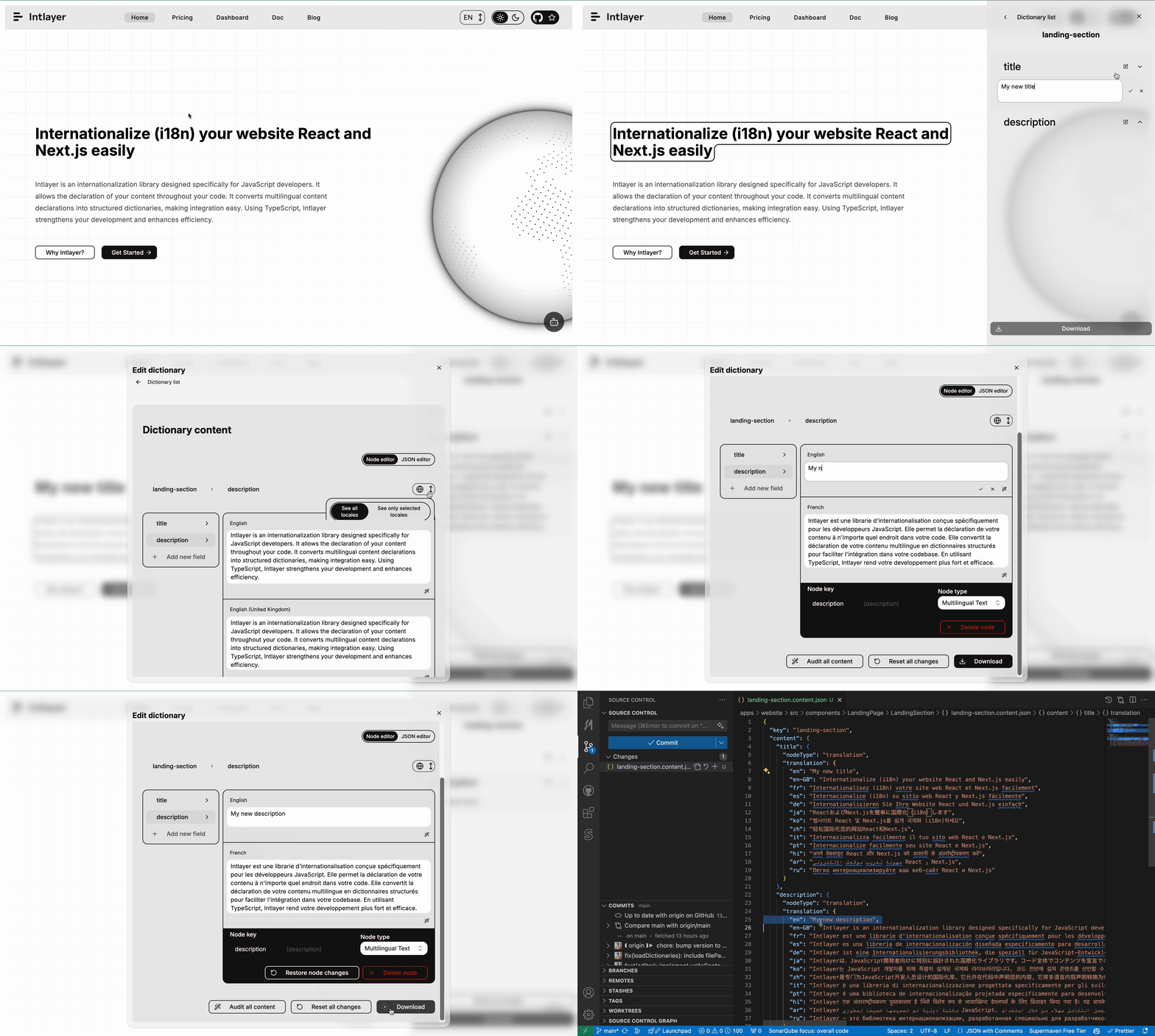
The intlayer-editor package is based on Intlayer and is available for JavaScript applications, such as React (Create React App), Vite + React, and Next.js.
Visual editor vs CMS
The Intlayer Visual editor is a tool that allows you to manage your content in a visual editor for local dictionaries. Once a change is made, the content will be replaced in the code-base. That means that the application will be rebuilt and the page will be reloaded to display the new content.
In contrast, the Intlayer CMS is a tool that allows you to manage your content in a visual editor for distant dictionaries. Once a change is made, the content will not impact your code-base. And the website will automatically display the changed content.
Integrate Intlayer into your application
For more details on how to integrate intlayer, see the relevant section below:
Integrating with Next.js
For integration with Next.js, refer to the setup guide.
Integrating with Create React App
For integration with Create React App, refer to the setup guide.
Integrating with Vite + React
For integration with Vite + React, refer to the setup guide.
How Intlayer Editor Works
The visual editor in an application that includes two things:
A frontend application that will display your website into a iframe. If your website uses Intlayer, the visual editor will automatically detect your content, and will allow you to interact with it. Once a modification is made, you will be able to download your changes.
Once you clicked the download button, the visual editor will send a request to the server to replace your content declaration files with the new content (wherever these files are declared in your project).
Note that Intlayer Editor will write your content declaration files as JSON if the file extension is.json. If the file extension is.ts,.tsx,.js,.jsx,.mjs,.cjs, it will write the file as a JavaScript file using a babel transformer.
Installation
Once Intlayer is configured in your project, simply install intlayer-editor as a development dependency:
Copy the code to the clipboard
With the --with flag, you can start the editor in parallel with another command:
Copy the code to the clipboard
Configuration
In your Intlayer configuration file, you can customize the editor settings:
Copy the code to the clipboard
import type { IntlayerConfig } from "intlayer";

const config: IntlayerConfig = {
  // ... other configuration settings
  editor: {
    /**
     * Required
     * The URL of the application.
     * This is the URL targeted by the visual editor.
     * Example: 'http://localhost:3000'
     */
    applicationURL: process.env.INTLAYER_APPLICATION_URL,
    /**
     * Optional
     * Default as `true`. If `false`, the editor is inactive and cannot be accessed.
     * Can be used to disable the editor for specific environments for security reason, such as production.
     */
    enabled: process.env.INTLAYER_ENABLED,
    /**
     * Optional
     * Default as `8000`.
     * The port of the editor server.
     */
    port: process.env.INTLAYER_PORT,
    /**
     * Optional
     * Default as "http://localhost:8000"
     * The URL of the editor server.
     */
    editorURL: process.env.INTLAYER_EDITOR_URL,
  },
};

export default config;
To see all available parameters, refer to the configuration documentation.
Using the Editor
When the editor is installed, you can start the editor using the following command:
bashCopy codeCopy the code to the clipboard
Note that you should run your application in parallel. The application URL should match the one you set in the editor configuration (
applicationURL).Note the command is reexported by the
intlayerpackage. You can usenpx intlayer editor startinstead.Then, open the URL provided. By default
http://localhost:8000.You can view each field indexed by Intlayer by hovering over your content with your cursor.

If your content is outlined, you can long-press it to display the edit drawer.
Environment configuration
The editor can be configured to use a specific environment file. This is useful when you want to use the same configuration file for development and production.
To use a specific environment file, you can use the --env-file or -f flag when starting the editor:
Copy the code to the clipboard
Note that the environment file should be located in the root directory of your project.
Or you can use the --env or -e flag to specify the environment:
Copy the code to the clipboard
Debug
If you encounter any issues with the visual editor, check the following:
The visual editor and the application are running.
The
editorconfiguration are correctly set in your Intlayer configuration file.- Required fields:
- The application URL should match the one you set in the editor configuration (
applicationURL).
- The application URL should match the one you set in the editor configuration (
- Required fields:
The visual editor use an iframe to display your website. Ensure that the Content Security Policy (CSP) of your website allows the CMS url as
frame-ancestors(http://localhost:8000by default). Check the editor console for any error.
Frequently Asked Questions
The visual editor edits local dictionaries and writes the change back into your code base, so it goes through your usual review and deployment. The CMS edits remote dictionaries, which change on the running site without a deployment. The editor suits content owned by developers; the CMS suits content owned by a marketing team.
Much less than a namespace based setup, because a page never downloads a catalog it does not render. Server rendered markup resolves its content on the server, and the build time compiler replaces useIntlayer calls with the exact dictionary entries a component uses, so unused keys and unused languages are dropped. Dynamic dictionaries split the rest per locale. Measured against the usual alternatives, Intlayer reduces bundle and page size by up to 50%. See bundle optimization and the benchmark.
Yes, and there are two paths. You can migrate the content progressively with the i18next migration guide or the next-intl migration guide. Or you can keep your current API entirely: the compat adapters expose the exact same API as i18next, react-i18next, next-intl, next-i18next, react-intl, use-intl, vue-i18n and Lingui, but served by Intlayer dictionaries, so imports change and component code does not.
Yes. The sync JSON plugin keeps your /messages/{locale}/{namespace}.json files as the source of truth and generates Intlayer dictionaries from them, in both directions. A sync PO plugin does the same for gettext catalogs, and per locale files let you split content by language instead of grouping locales in one file.
No. Run npx intlayer extract and Intlayer reads your source files, pulls the user facing strings out and writes a .content file next to each one, so you review a diff instead of copying strings into a catalog one at a time. See the extract command.
For a fully automated pipeline, the Intlayer Compiler does the same at build time on JSX, TSX, Vue and Svelte source, generating the dictionaries on every change so there are no keys to maintain by hand. It works by static analysis, so strings that only exist at runtime stay out of reach, and it needs a few annotations to tell user facing text apart from application logic.
Five pieces, all optional:
- VS Code extension: jump from a
useIntlayerkey to the content file that declares it, extract content from a component, and run build, fill, test, push and pull from the command palette or a dedicated Intlayer tab. - LSP server: the same awareness in any editor that speaks LSP, with go to definition, find all references, hover previews of a translated value, autocompletion of keys and fields, and a warning when a key is not declared anywhere. It also resolves
i18next,react-i18next,next-intlanduse-intlcalls, which helps while you migrate. - MCP server: exposes the Intlayer documentation and CLI to Cursor, VS Code, Claude Desktop, Claude Code and ChatGPT, so an assistant answers from current docs instead of guessing, and can run commands such as
intlayer fillitself. - Agent skills: focused skills such as
intlayer-config,intlayer-cliandintlayer-content, plus one per framework, that teach an agent your routing setup and the content node types. - ESLint plugin:
no-raw-textflags hardcoded strings, with further rules for static dictionary keys and unused content.