
Ask your question and get a summary of the document by referencing this page and the AI provider of your choice
The content of this page was translated using an AI.
See the last version of the original content in EnglishIf you have an idea for improving this documentation, please feel free to contribute by submitting a pull request on GitHub.
GitHub link to the documentationCopy doc Markdown to clipboard
The History of JavaScript Internationalisation (i18n)
Internationalisation is not new. Long before JavaScript and the modern web, software already had to handle multiple languages, currencies, date formats, and regional conventions. Early graphical operating systems such as GEM and Mac OS were addressing many of these challenges back in the 1980s.
The same principles eventually found their way into backend frameworks. Ruby on Rails, Django, Java ecosystems, and PHP applications each created their own approach to internationalisation. The core questions were clearly defined:
- Where should translations reside?
- How do we format dates, numbers, and currencies?
- How do we handle plurals and grammatical variances?
- How do we select the appropriate language for a given user?
When the server generated the entire page, the workflow remained straightforward. The application loaded the relevant translations, compiled the HTML, and sent the markup to the browser.
Note that PHP and GNU gettext served as precursors for the t() helper pattern that later became ubiquitous in JavaScript and JSX.
Then JavaScript began taking over the browser.
As applications migrated from server-rendered web pages to increasingly sophisticated Single-Page Applications (SPAs), internationalisation became a frontend responsibility as well. The browser suddenly needed to fetch translations, toggle languages dynamically, format values, process plurals, and update the interface without a full page refresh.
That introduced a central question:
How do you build a multilingual application without delivering a massive payload of translation data and runtime code to every single user?
That challenge has shaped JavaScript i18n for over a decade.
The solutions have evolved substantially. We progressed from global objects and t('some.key') lookups, to dedicated framework libraries, compile-time extraction, TypeScript-generated types, Server Components, tree-shaking, and ultimately compiler-driven workflows where translation content is converted into optimised JavaScript during build time.
This article reviews that evolution from roughly 2011 to 2026: the objectives of each tooling generation, what succeeded, what fell short, and how frontend architectural changes continue to define how we handle i18n today.
Table of Contents
The Early Web: JavaScript Internationalisation Before 2016
To appreciate where modern i18n solutions stand today, it helps to revisit the realities of web development between 2011 and 2015.
The Shift Towards the Client
In the early 2010s, internationalisation was primarily handled on the server. JavaScript acted mostly as a progressive enhancement layer for animations, form validations, and small jQuery DOM components.
With the rise of SPAs via Backbone.js, Knockout.js, and early AngularJS, rendering responsibilities moved into the browser. Client-side code needed to present localised dates, format currencies, handle pluralisation, and swap out copy on the fly without refreshing the page.
However, the browser landscape of 2011 was ill-prepared for these demands:
The ECMAScript Internationalisation API specification (ECMA-402) was only finalised in December 2012, introducing the global Intl object. Prior to broad browser support for Intl, even standard date and number formatting required bespoke functions or heavy polyfills.
Tools such as Webpack were only just emerging, and native ES modules did not exist in browsers. Developers loaded scripts with <script> tags, often assigning translation dictionaries to global variables such as window.translations = { ... }.
Translations were authored in large, centralized JSON files. A user in Tokyo loading a simple homepage still downloaded strings for user settings, billing dialogues, and administrative panels.
The First Wave of Client-Side Libraries
Between 2012 and 2015, the initial foundation of modern JavaScript i18n was laid down:
Created by Jan Mühlemann, i18next established the convention for runtime key-value dictionaries in JavaScript. It introduced key traversal, variable interpolation, pluralisation rules, and a pluggable architecture for language detectors and backends. It quickly became the standard across vanilla JS and early Node.js backends.
Authored by Kazuya Kawaguchi (Kazupon), vue-i18n tailored internationalisation directly to Vue.js reactive data binding, introducing template directives (v-t) and the $t() helper.
Developed by Yahoo! as part of the FormatJS initiative, react-intl brought standardized ICU MessageFormat and browser Intl APIs into React through declarative components like <FormattedMessage> and <FormattedDate>.
Jan Mühlemann introduced i18next to the expanding React community, utilising Higher-Order Components (withTranslation) and React context providers to trigger re-renders on language updates.
Limitations of the Pre-2016 Era
While these libraries enabled rich multilingual client experiences, architectural limitations of the period created persistent problems:
Key lookups like t('marketing.landing.hero.cta') provided no static guarantees. A typo went unnoticed until runtime, showing blank elements or raw translation keys in production.
Evaluating ICU message syntax and processing regular-expression interpolations at runtime consumed measurable CPU cycles on mobile devices.
Without route-based or component-level code splitting, all localised strings were bundled together, increasing initial load times.
Dictionaries lived in centralised JSON files separated from the components rendering them, making orphan keys and omitted translations frequent occurrences.
The Framework Era: Evolution Across Ecosystems
Between 2016 and 2026, frontend architecture matured substantially. TypeScript became the industry norm, component models advanced, bundlers like Webpack, Vite, and Turbopack introduced granular code splitting, React Server Components shifted rendering logic back to the server, and compilers began parsing application structures directly.
The tabs below detail how each ecosystem addressed these challenges, highlighting release timelines, core motivations, and major innovations. Across these frameworks, react-intlayer and its counterparts (next-intlayer, vue-intlayer, angular-intlayer, svelte-intlayer, and solid-intlayer) provide high-performance solutions tailored to each runtime environment.
Open the table in a modal to view all data content clearly
| First Release | Library | Author | What It Set Out to Solve | Key Innovation |
|---|---|---|---|---|
| January 2012 | i18next | Jan Mühlemann (@jamuhl) | Standardise runtime dictionary lookups for browser and Node.js without framework lock-in. | Pluggable runtime architecture separating core translation from loaders, detectors, and caching. |
| February 2021 | typesafe-i18n | Ivan Hofer (@ivanhofer) | Prevent silent runtime errors and broken interpolations caused by untyped string keys. | Fully typed translation functions generated directly from translation objects with zero runtime dependencies. |
| October 2023 | paraglide (@inlang/paraglide-js) | Samuel Stroschein (@samuelstroschein) / Inlang (@inlang) | Eliminate runtime dictionary lookups, heavy parsers, and bundle bloat. | Compiles messages into tree-shakable ECMAScript modules and plain JS functions. |
| August 2024 | intlayer | Aymeric Pineau (@aymericzip) | Replace unmaintainable namespaces, avoid cross-page content leakage, reduce git merge conflicts, and solve the lack of native type safety in the TypeScript era. | Collocates .content files directly where functions are called to split code cleanly, auto-generates TypeScript types, and provides built-in visual CMS and AI CLI tools. |
| June 2025 | wuchale | Kidus Adugna (@K1DV5) | Remove the friction of manually extracting text strings and inventing translation keys during development. | AST-level preprocessing that detects inline text and compiles it into zero-wrapper localised functions at build time. |
Open the table in a modal to view all data content clearly
| First Release | Library | Author | What It Set Out to Solve | Key Innovation |
|---|---|---|---|---|
| June 2014 | react-intl | Yahoo! / FormatJS | Standardise formatting for numbers, dates, currencies, and complex plurals in React. | Declarative components (<FormattedMessage>, <FormattedDate>) implementing ICU MessageFormat and ECMA-402 standards. |
| December 2015 | react-i18next | Jan Mühlemann (@jamuhl) | Provide an idiomatic React binding for i18next with reactive re-rendering. | Evolved with React from Higher-Order Components to <Trans> JSX interpolation and the useTranslation hook. |
| January 2018 | @lingui/react | Tomáš Ehrlich (@tricoder42) | Reduce JavaScript bundle size penalties caused by runtime ICU parsers. | Compile-time Babel/SWC macros compiling <Trans> and t into compact indexed arrays at build time. |
| December 2020 | use-intl | Jan Amann (@amannn) | Deliver a lightweight, hook-first, type-safe alternative to legacy React i18n libraries. | Ergonomic useTranslations and useFormatter hooks with deep TypeScript integration. |
| February 2021 | @tolgee/react | Jan Cizmar (@jcizmar) | Eliminate the slow feedback loop between developers, translators, and designers. | In-context browser editing allowing users to Alt-click text, edit translations in place, and capture screenshots. |
| August 2024 | react-intlayer | Aymeric Pineau (@aymericzip) | Deliver a high-performance React implementation of Intlayer tailored specifically for the React component lifecycle, eliminating centralized JSON files and unmaintainable namespaces. | High-performance useIntlayer hook tailored for React rendering, auto-generated TypeScript types, per-component bundle tree-shaking, and live visual CMS sync. |
| July 2024 | gt-react | Ernest McCarter (@eoinest) | Automate manual file exports, translator handoffs, and translation maintenance. | Cloud-native automated AI localisation directly inside React components with machine translation pipelines. |
| June 2025 | @wuchale/jsx | Kidus Adugna (@K1DV5) | Eliminate manual key naming and boilerplate translation hooks in React JSX authoring. | AST transformation that automatically extracts raw JSX text nodes and compiles them into localised equivalents. |
Open the table in a modal to view all data content clearly
| First Release | Library | Author | What It Set Out to Solve | Key Innovation |
|---|---|---|---|---|
| November 2018 | next-i18next | Isaac Hinman (@isaachinman) | Support SSR and SSG with i18next in Next.js Pages Router without client waterfalls. | serverSideTranslations and appWithTranslation passing localised namespaces to page props. |
| December 2020 | next-translate | Arvin Wiyono (@arvinn) / Vinissimus (@vinissimus) | Simplify configuration and reduce bundle weight in Next.js Pages Router apps. | Webpack loader plugin automatically injecting only the necessary translation namespaces per page. |
| December 2020 | next-intl | Jan Amann (@amannn) | Re-architect Next.js internationalisation for App Router, React Server Components (RSC), and streaming SSR. | Native integration with Next.js App Router middleware, Server Actions, and asynchronous Server Components without client JS. |
| July 2022 | next-international | Tom Dussaix (@tom-dussaix) | Maximise TypeScript type safety with minimal client bundle overhead for Next.js. | Strict type generation for scoped translation keys with lightweight App Router and Pages Router adapters. |
| October 2023 | paraglide-next (@inlang/paraglide-next) | Samuel Stroschein (@samuelstroschein) / Inlang (@inlang) | Bring zero-runtime compiled messages to Next.js App Router and Pages Router. | Middleware routing paired with tree-shakable message functions avoiding runtime JSON parsing in RSC and client bundles. |
| August 2024 | next-intlayer | Aymeric Pineau (@aymericzip) | Deliver a high-performance Server Component adapter for Next.js App Router and Pages Router, eliminating the need to pass t() functions or dictionaries as props. | Native Server Component adapter allowing useIntlayer to be called directly in synchronous Server Components without prop-drilling, paired with zero-waterfall server rendering and live visual CMS synchronisation. |
| July 2024 | gt-next | Ernest McCarter (@eoinest) | Automate multilingual content generation and dynamic localised routing in Next.js using AI translation. | App Router integration pairing cloud-based machine translation with Next.js edge middleware and caching layers. |
Open the table in a modal to view all data content clearly
| First Release | Library | Author | What It Set Out to Solve | Key Innovation |
|---|---|---|---|---|
| May 2014 | vue-i18n | Kazupon (@kazupon) | Provide idiomatic, reactive internationalisation for Vue applications. | Deep reactivity integration, template directives (v-t), $t helpers, and single-file component <i18n> custom blocks. |
| November 2017 | @nuxt/i18n | Nuxt Community | Handle localised URL routing, SEO hreflang tags, and SSR hydration in Nuxt. | Full-stack routing module generating localised routes (prefix, domain), SEO meta headers, and lazy chunk loading. |
| August 2020 | fluent-vue | Mozilla (@mozilla) / Demivan (@demivan) | Handle complex grammatical gender, cases, and asymmetric language structures in Vue. | Vue integration for Mozilla Project Fluent syntax, avoiding complex conditional code for linguistic variations. |
| January 2025 | vue-intlayer | Aymeric Pineau (@aymericzip) | Deliver a high-performance Vue implementation of Intlayer engineered natively for Vue 3 Composition API and Nuxt, avoiding global namespace pollution. | High-performance useIntlayer composable tailored for Vue 3 reactive dependency tracking, direct component scoping, and visual editor integration. |
Open the table in a modal to view all data content clearly
| First Release | Library | Author | What It Set Out to Solve | Key Innovation |
|---|---|---|---|---|
| February 2017 | ngx-translate | Olivier Combe (@ocombe) | Provide dynamic runtime translation in Angular without deploying separate bundles per locale. | TranslateService and translate pipe enabling dynamic translation loading and runtime language toggling. |
| July 2019 | @ngneat/transloco | Netanel Basal (@NetanelBasal) & Shahar Kazaz (@shahar_k) | Resolve performance bottlenecks, lack of scoping, and missing features in older Angular libraries. | Structural directive (*transloco), scoped translations for lazy-loaded feature modules, SSR support, and extraction CLI. |
| September 2019 | @angular/localize | Angular Team (@angular) | Modernise Angular built-in compile-time i18n to avoid recompiling TypeScript for each language. | Tagged template literals with $localize injected as a fast post-build step in the Ivy compiler engine. |
| February 2021 | @tolgee/ngx | Jan Cizmar (@jcizmar) | Integrate collaborative in-context translation and screenshot capturing into Angular workflows. | Angular pipes and directives connected directly to Tolgee for live in-browser localisation. |
| March 2026 | angular-intlayer | Aymeric Pineau (@aymericzip) | Deliver a high-performance Angular implementation of Intlayer engineered natively for modern Angular (Signals, standalone components, and SSR). | High-performance Signal-based reactive content integration tailored for modern Angular change detection, standalone DI, and live visual CMS sync. |
Open the table in a modal to view all data content clearly
| First Release | Library | Author | What It Set Out to Solve | Key Innovation |
|---|---|---|---|---|
| July 2018 | svelte-i18n | Kaisermann (@kaisermann) | Provide an idiomatic, reactive internationalisation library tailored to Svelte reactive stores. | Store-backed $t lookup ensuring fine-grained reactive DOM updates when the locale changes. |
| December 2021 | sveltekit-i18n | Ivan Fevrier (@ivanfevrier) | Handle SSR and route-based translation loading cleanly in SvelteKit applications. | Modular loader architecture fetching only the translations and formatters needed for the active SvelteKit route. |
| November 2021 | @tolgee/svelte | Jan Cizmar (@jcizmar) | Enable in-context localisation in Svelte applications. | Svelte store bindings integrating with the Tolgee in-context translation overlay and automated screenshot generation. |
| October 2025 | svelte-intlayer | Aymeric Pineau (@aymericzip) | Deliver a high-performance Svelte implementation of Intlayer engineered natively for Svelte 5 and SvelteKit. | High-performance reactive content bindings tailored for Svelte 5 Runes ($state), component-scoped .content declarations, and visual CMS. |
| July 2025 | @wuchale/svelte | Kidus Adugna (@K1DV5) | Remove boilerplate of declaring dictionaries and importing $t functions in Svelte components. | Svelte preprocessor parsing templates at build time and compiling text nodes into zero-wrapper localised outputs. |
Open the table in a modal to view all data content clearly
| First Release | Library | Author | What It Set Out to Solve | Key Innovation |
|---|---|---|---|---|
| September 2021 | @solid-primitives/i18n | SolidJS Community | Provide an idiomatic i18n primitive matching SolidJS fine-grained reactivity. | Signal-based reactive translation resolver updating DOM nodes without a virtual DOM or unnecessary re-renders. |
| July 2025 | solid-intlayer | Aymeric Pineau (@aymericzip) | Deliver a high-performance SolidJS implementation of Intlayer engineered natively for SolidJS and SolidStart. | High-performance Signal-aware content bindings tailored for Solid fine-grained reactive primitives without Virtual DOM overhead, full TypeScript schema autocompletion. |
| June 2026 | @lingui/solid | Tomáš Ehrlich (@tricoder42) | Extend compile-time macro extraction and ICU MessageFormat support to SolidJS. | Macro transformations adapted to Solid fine-grained reactivity, compiling messages into compact runtime structures. |
The Four Architectural Eras of JavaScript i18n
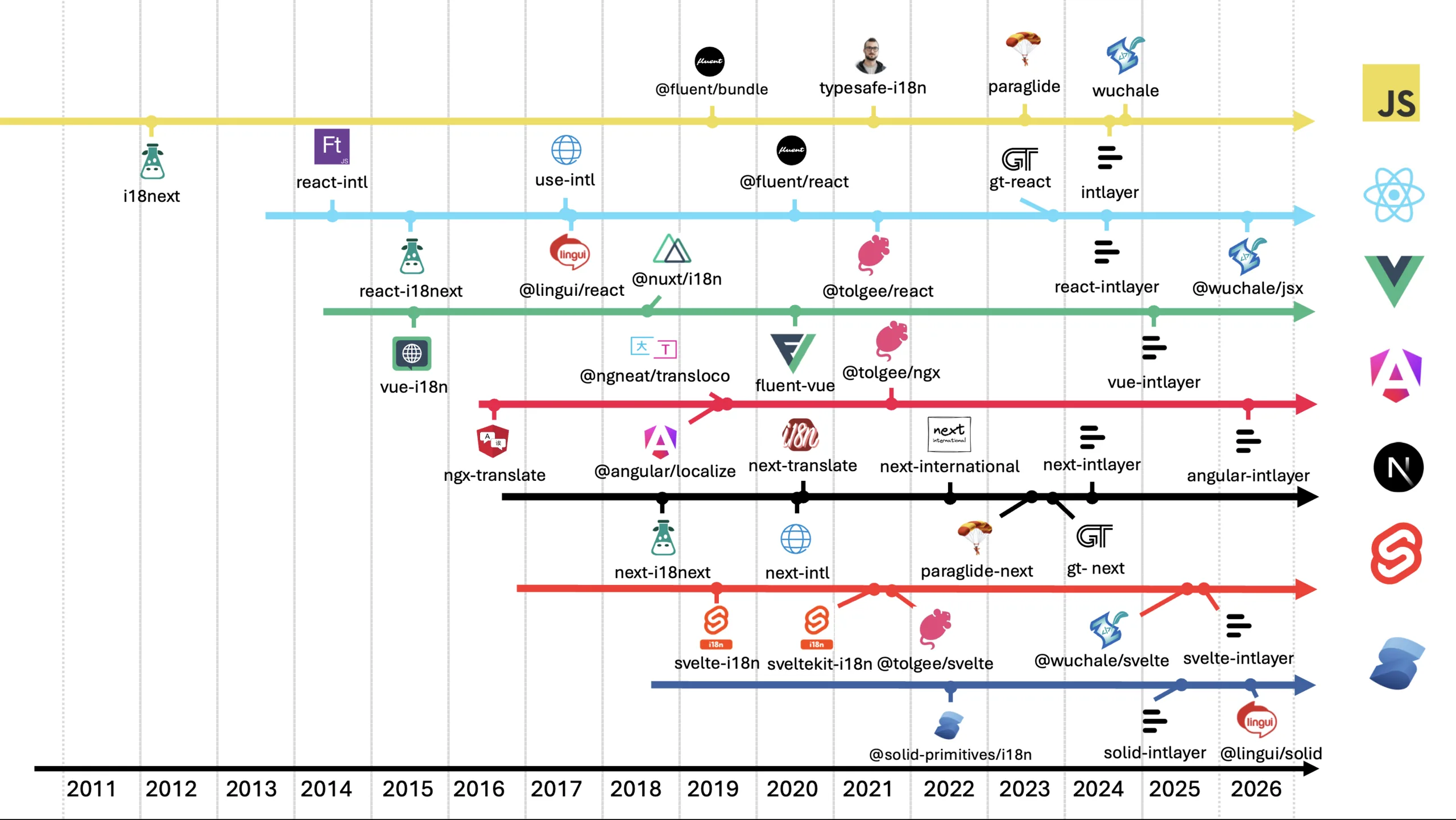
Looking across fifteen years of development, we can categorise the history of JavaScript internationalisation into four distinct architectural eras:
Characterised by i18next, react-intl, and vue-i18n. Applications loaded static JSON catalogues into memory, and runtime functions matched string keys against nested objects. Pluralisation and interpolation were handled in the browser through regex matching and runtime ICU parsers.
Characterised by lingui, next-translate, transloco, and typesafe-i18n. Developers recognised the performance penalties of runtime parsing and the fragility of untyped keys. Babel macros extracted messages at build time, bundler plugins sliced dictionaries per page, and TypeScript compilers began verifying translation arguments.
Characterised by next-intl, next-international, and early RSC adapters. With the advent of React Server Components and Next.js App Router, the objective shifted to rendering localised content on the server without shipping translation dictionaries or client-side i18n runtimes to the browser.
Characterised by paraglide, intlayer, and wuchale. Modern tools treat internationalisation not merely as string replacement, but as an integrated content architecture. Compilers convert messages directly into tree-shakable code functions, content declarations are collocated with components, and visual editors, MCP tools, and automated AI translation pipelines integrate directly into the developer workflow. In this model, Intlayer decouples content declaration and automatic type generation from runtime delivery, providing dedicated, high-performance implementations (react-intlayer, next-intlayer, vue-intlayer, angular-intlayer, svelte-intlayer, and solid-intlayer) engineered natively for each framework's reactivity and runtime environment.
Conclusion: Balancing DX, Performance, and the AI Evolution
Across fifteen years and four distinct architectural waves, the central challenge of JavaScript internationalisation has remained consistent: reconciling developer experience (DX) and long-term codebase maintainability while delivering optimal performance on the client side.
What began as global variables and unmaintainable centralised JSON files has progressively matured into component-collocated content, automated TypeScript type safety, zero-waterfall server rendering, and compile-time tree shaking.
AI Automation and the Evolution of Localization Platforms
A significant shift in recent years has been automated AI translation generation, which fundamentally challenges the traditional operating models of legacy localisation platforms.
Historically, centralising content into monolithic JSON files was a compromise made to ease the integration of Translation Management Systems (TMS). A single centralised file gave external translators and third-party TMS platforms an easy import and export target. However, this came at a high architectural cost for developers: frequent git merge conflicts across branches, untracked orphan keys, lack of component-level context, and unmaintainable global namespaces.
With modern generative AI and compilation tooling, Developer Experience (DX) has returned to the forefront. Build tools and CLIs can now discover, validate, and translate component-collocated content files automatically, eliminating the need to sacrifice clean architecture for translation pipelines.
For over a decade, commercial translation suites built recurring revenue around that manual TMS friction:
- Solutions like Locize (the commercial SaaS behind
i18next) and Crowdin (the primary sponsor and integration partner for multiple open-source libraries) structured their models around hosted translation storage, tier limits, and word-count fees. - Because these legacy platforms monetise volume and manual workflows, they have little economic incentive to automate end-to-end translation generation for free directly in developer toolchains.
Modern AI Approaches vs. Direct Provider Costs
As modern Large Language Models lowered translation costs to fractions of a cent while increasing linguistic accuracy, a new generation of commercial tools emerged to capture this market:
- Platforms such as lingo.dev or General Translation (
gt-react,gt-next) have introduced proprietary subscription tiers and intermediated cloud pipelines. - In contrast, Intlayer provides automated AI translation directly out of the box through its CLI, allowing teams to connect their own API keys (such as OpenAI, Anthropic, Mistral, or Google Gemini). There are no markups, commissions, or vendor lock-in, running strictly at the direct, raw cost of your chosen AI provider.
More Than i18n: A Complete Multilingual Content System
Finally, modern web development has expanded far beyond simple string replacement. Today's applications do not just need to translate single words like "Submit" or "Log In", they require rich, dynamic, and structured content across complex user journeys.
Intlayer approaches this problem not as a narrow string-key lookup tool, but as a comprehensive multilingual content system. With first-class support for Markdown documents, HTML structures, nested data schemas, and seamless visual CMS editing, it bridges the gap between code-level engineering, automated AI workflows, and content management.
For deeper architectural comparisons and practical migration guides, explore the following resources:
Comments
No comments yet. Be the first to share your thoughts.