
Ask your question and get a summary of the document by referencing this page and the AI provider of your choice
The content of this page was translated using an AI.
See the last version of the original content in EnglishIf you have an idea for improving this documentation, please feel free to contribute by submitting a pull request on GitHub.
GitHub link to the documentationCopy doc Markdown to clipboard
How to pick the right Svelte i18n library
Svelte ships nothing for i18n. No $t, no locale primitive, no message format. Every option is a third-party choice, and the Svelte ecosystem is where compile-time i18n has gone furthest, so the candidates differ more from each other than in React or Vue.
This guide lists the questions to answer first, then maps the answers to svelte-i18n, Paraglide, typesafe-i18n, wuchale and Intlayer, for Vite + Svelte and for SvelteKit.
Table of Contents
Six questions to answer before comparing libraries
- Vite SPA or SvelteKit? In an SPA a module-level store is correct: one tab, one user, one locale. On SvelteKit that same singleton is shared across concurrent requests on the server, and request B renders in request A's language. The library either gives you a per-request shape (context,
locals) or leaves it to you. - Who writes the translations? Developers, a TMS, an agency delivering ICU strings, or an AI pipeline.
svelte-i18nspeaks ICU. Paraglide andtypesafe-i18nuse their own syntax. Match the vendor. - How many locales and pages? Two locales and five pages can ship everything. Ten locales and forty routes cannot, and the difference between runtime catalogues and compiled messages becomes the main cost.
- Do you need types on keys?
$_("cart.totl")is a runtime failure insvelte-i18n. Compile-time libraries make it a type error by construction. - Svelte 4 stores or Svelte 5 runes? Runes change the syntax of the locale state, not the sharing problem. But
$statein a.tsfile compiles to a plain variable, so the library's runtime has to be rune-aware if you are on Svelte 5. - Can you live with generated files in the repo? Paraglide and
typesafe-i18nboth generate JavaScript or TypeScript into your source tree. Some teams are fine with that, others get merge conflicts on every parallel branch.
Write the answers down. Everything below refers back to them.
The landscape in one picture
Svelte i18n arrived later than React or Vue, and skipped straight to the compile-time waves.
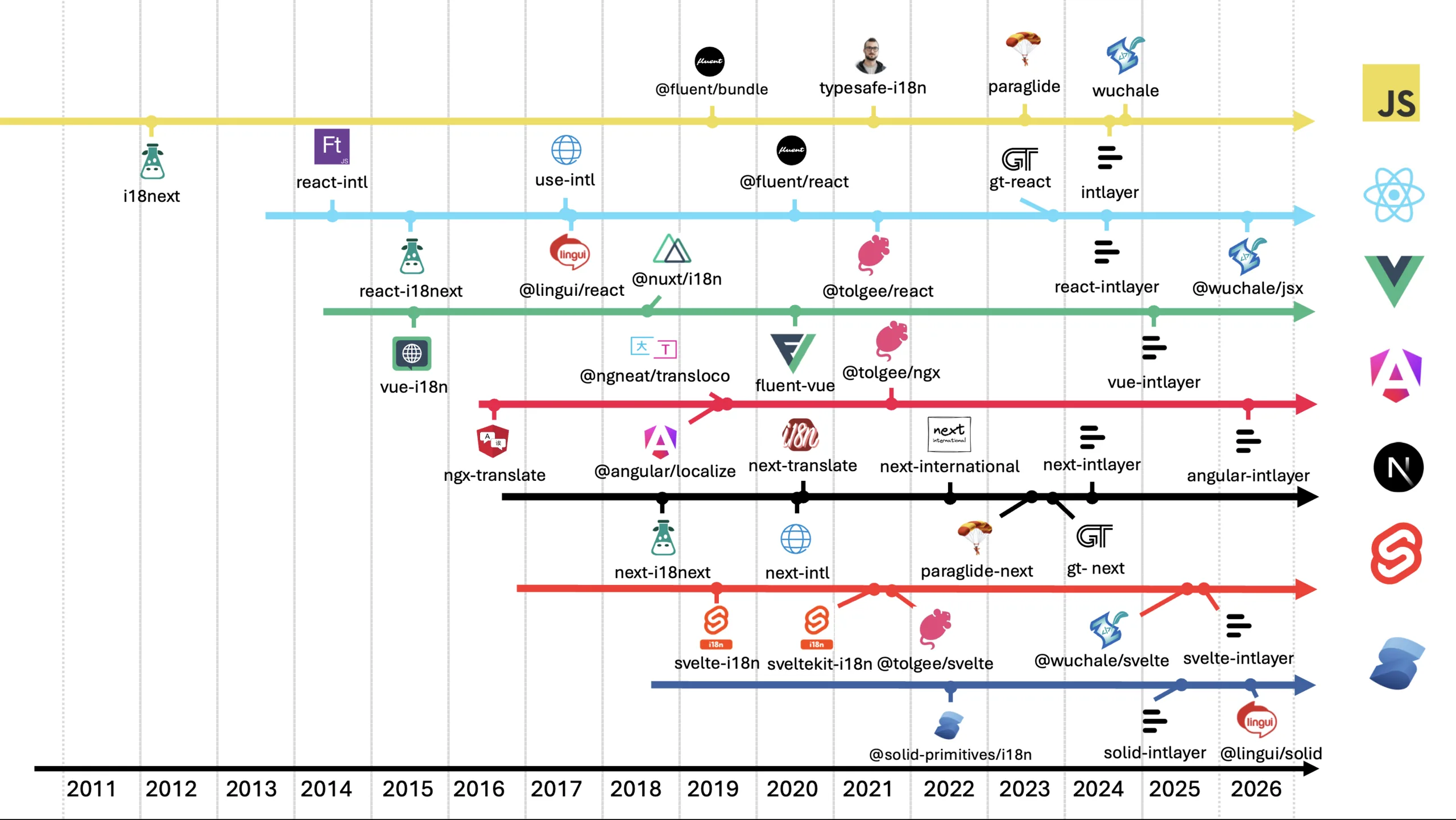
JSON catalogues, ICU parsed in the browser through intl-messageformat, locale in module-level stores ($locale, $_). Most adopted, well documented, SSR wiring is yours.
A generator watches your catalogues and emits typed accessors ($LL.cart.total()). Sound model, generated files in the repo, and the repository has not moved much recently.
Paraglide compiles each message to an exported function so the bundler tree-shakes what a route never calls. wuchale extracts strings from markup at build. Intlayer declares content per component and generates types and per-component dictionaries.
The history of JavaScript i18n covers each wave in detail.
The decision that matters most: where content lives and when it loads
Two structural choices explain most of the bundle difference between setups:
- Centralised or scoped content. One
locales/en.jsonfor the app, or one declaration per component. - Static or dynamic import. Everything at startup, or the active locale (and ideally the active route) fetched on demand.
The graph estimates the payload for a theoretical app of 1 to 10 pages, translated into 1 to 10 locales, with about 30 KB of text per page.
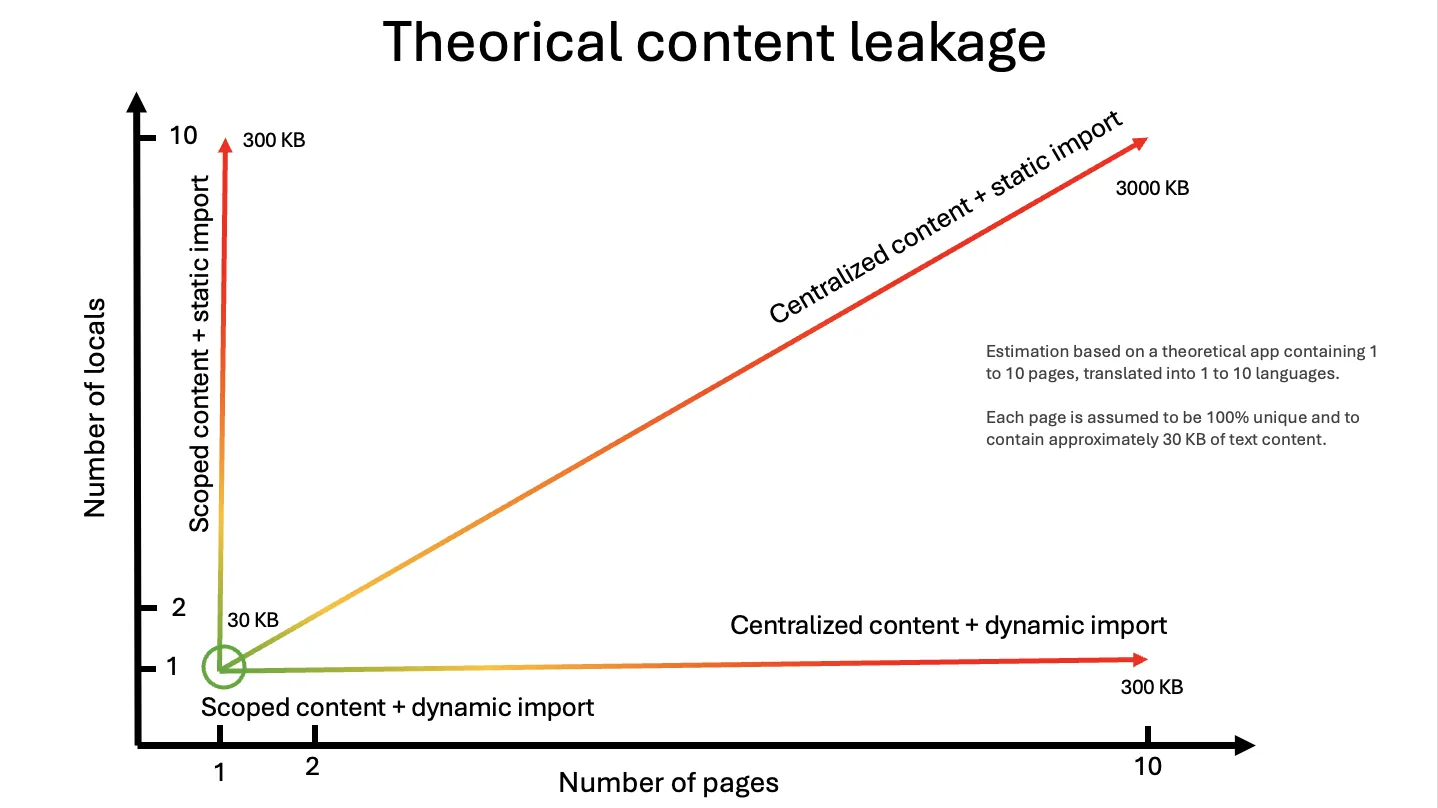
svelte-i18n sits in the top-left by default: register("fr", () => import("./fr.json")) gives you dynamic loading per locale, but a locale catalogue is one object and loading it loads every page's copy. Paraglide is the interesting case: because every message is its own export, tree-shaking gives you the page axis for free, and the Svelte benchmark confirms it works as advertised on Vite + Svelte (it did not in the React and Next.js benchmarks). Intlayer gets to the same corner through per-component declarations.
If your answer to question 3 was "many pages", weigh this section more than any API preference. The per-component vs centralised i18n post covers the maintenance side of the same trade-off.
The candidates
Library sizes are from the Svelte benchmark: store plus accessor in an empty component, after bundling, tree-shaking and minification, on a 10-page, 10-locale app. Content is measured separately.
Open the table in a modal to view all data content clearly
| Library | Messages live in | Locale state | Type safety | Message format | Per-route splitting | Library size |
|---|---|---|---|---|---|---|
svelte-i18n | JSON catalogues per locale | Module-level Svelte store | 2/5 — Manual union | ICU | No | ~16.6 kB |
typesafe-i18n | Generated TS modules | Store adapter | 4/5 — Generated | Own | Partial | Small |
| Paraglide | inlang project, compiled to functions | Read per call from cookie, URL or storage | 3.5/5 — Generated | Own | Yes, via tree-shaking | Near zero (due to generated code in the codebase) |
wuchale | Extracted from markup at build | Store | N/A (no keys) | Own | Yes | ~30.7 kB |
| Intlayer | .content.ts next to the component | Context plus store, rune-aware | 5/5 — Generated, default | Intlayer (+ ICU, i18next, PO) | Yes, per component | ~3.6 kB |
Numbers are a snapshot at the benchmark's versions. Run it on your own app before deciding on size alone. Type safety: 5/5 means keys, parameters and every locale are checked without manual setup, including url formater and helpers.
Paraglide's near-zero library size is by construction: the runtime is generated into your repository. Intlayer needs vite-intlayer, so it cannot run without a build step.
Commit activity
Commits show how much work goes into each project. Monorepos count every package they ship, so read the number as a signal of activity, not of quality.
- kaisermann/svelte-i18n
- codingcommons/typesafe-i18n
- opral/paraglide-js
- wuchalejs/wuchale
- aymericzip/intlayer
Commits on the default branch, source: GitHub API.
npm downloads
- svelte-i18n
- typesafe-i18n
- @inlang/paraglide-js
- wuchale
- svelte-intlayer
Source: npm registry downloads API.
Downloads reward the oldest solutions, not the best ones. A library released years ago is still installed by every project that chose it back then, by every CI run and by every package that depends on it. The count measures inertia more than a fresh choice.
AI assistants amplify the effect. next-intl, i18next and vue-i18n are everywhere in the code they were trained on, so they suggest them by default, without comparing the alternatives. Each suggestion adds downloads, which feeds the next suggestion. Compare on the benchmark rather than on the download count.
Match your answers to a library
svelte-i18n. It is the most documented option, $_ reads naturally in markup, and register plus waitLocale() covers lazy loading per locale. Gate the first paint on isLoading or you will flash raw keys. If the app might grow a server later, put the locale in Svelte context from day one instead of relying on the module store; it costs nothing now and saves a production-only bug later.
The sharing problem decides this one. svelte-i18n works on SvelteKit but the per-request wiring (hooks.server.ts, locals, load, then setContext) is yours to write and easy to get subtly wrong. Paraglide ships a SvelteKit integration that handles routing and reads the locale per call, which sidesteps the singleton. Intlayer sets the locale from load data into context. The SvelteKit i18n post explains the [[lang]] versus reroute choice, which you should make before picking the library.
svelte-i18n is ICU-native through intl-messageformat, so it plugs into most vendors directly. Paraglide and typesafe-i18n use their own syntax and need conversion. Intlayer's ICU support is partial, so if you receive ICU strings today, treat that as a blocker.
Compile-time. Paraglide's tree-shaking works on Vite + Svelte and the library cost is near zero. Intlayer's per-component dictionaries give the same result without generated files in the repo. svelte-i18n ships the ICU parser plus the whole catalogue and lands around 4.5× svelte-intlayer in the benchmark before any content.
Anything but a bare svelte-i18n setup, where the only typing is a hand-written union that drifts from the JSON immediately. typesafe-i18n, Paraglide and Intlayer all generate types from the content. Check typesafe-i18n's repository activity before committing a codebase to it. The detecting missing translations post compares what each catches at build time.
That removes Paraglide and typesafe-i18n. svelte-i18n and Intlayer keep their output in node_modules or a build directory; with Intlayer the .content.ts files are hand-written source, the compiled dictionaries and types live in .intlayer/ and are ignored.
Then the centralised JSON has no consumer left to justify it. Colocated content plus a CLI that fills the missing locales is the shorter path. Intlayer's fill command runs against your own API key (OpenAI, Anthropic, Mistral, Gemini) and only re-translates what changed. Paraglide's inlang ecosystem offers hosted equivalents with their own plans.
Where each library falls short
svelte-i18n: heaviest of the set, no key types, no per-route splitting, module-level store that leaks across requests on SvelteKit unless you wire context yourself.typesafe-i18n: a watcher process, generated files in the repo, and a repository that has not moved much recently.- Paraglide: generated files committed to the repo and regenerated before every push, merge conflicts on parallel branches, and the locale is read from cookie or storage on each message call rather than from a store, which costs work on locale change.
wuchale: interesting extraction idea, still early. The React benchmark hit reactivity issues that required forcing provider re-renders, and the documentation is thin.- Intlayer: mandatory build plugin, smaller ecosystem, partial ICU support, and content spread across the codebase by design, so exporting one JSON for a translator needs tooling.
What each option looks like in code
The same component, a cart summary with a title and a plural, written with each candidate. The interesting part is not the markup, it is where the content lives, how the locale is stored, and what the type checker knows.
Copy the code to the clipboard
Copy the code to the clipboard
Copy the code to the clipboard
Copy the code to the clipboard
ICU through intl-messageformat, locale in a module-level store. $_ accepts any string; the only typing is a union you write by hand.
Copy the code to the clipboard
Copy the code to the clipboard
Copy the code to the clipboard
Copy the code to the clipboard
Every message is a generated, typed function, tree-shaken if never called. The paraglide/ folder is generated into your repo, and the locale is read per call rather than from a store.
Copy the code to the clipboard
Copy the code to the clipboard
Copy the code to the clipboard
Copy the code to the clipboard
Typed accessors generated by a watcher process. The model is sound; the generated files live in the repo and the project has been quiet recently.
Copy the code to the clipboard
Copy the code to the clipboard
All locales in one file beside the component. useIntlayer returns a readable store, so $content is the auto-subscription you already know, and the locale is held in context (SSR-safe) rather than a module singleton.
Already on svelte-i18n? The @intlayer/svelte-i18n compat adapter aliases the package at the bundler level so $_, $date, $number and your flat keys keep working while Intlayer serves the content.
Before you commit
A feature table tells you what a library does today. These points tell you what living with it will be like.
Check repository activity.
Commits, issue response time, and whether the last minor release was this year. A sound design with no maintainer is a migration in waiting.
Do not pick by npm downloads.
The most installed library is the one that shipped first, not the one that fits a 2026 Svelte codebase. Downloads measure history, not fit.
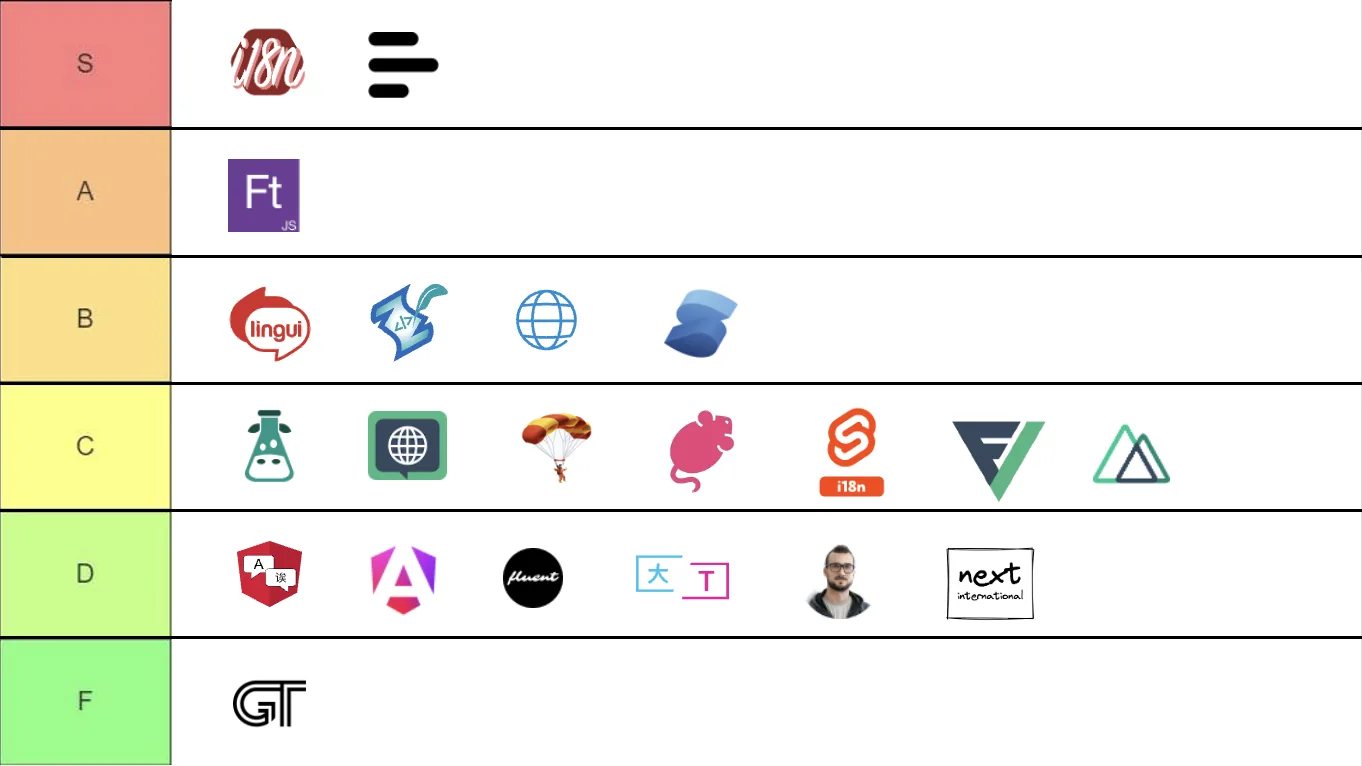
Ask who pays the maintainer, and what they sell.
svelte-i18n is backed by Crowdin, like next-intl and vue-i18n. i18next is backed by Locize. Tolgee, Paraglide (inlang) and Intlayer each run their own platform. A vendor whose revenue is hosted translation has little reason to make translation free inside your toolchain. Intlayer is the only one of the set that ships AI translation through the CLI with your own API key, and a CMS you can self-host.
Is it AI-agent ready?
Agents still struggle with i18n: they forget locales, invent keys, and mix message syntaxes. Does the library ship Agent Skills or an MCP server so the agent can list, fill and test content? And is content loading optimised by default, or does someone have to review namespaces and lazy imports every quarter?
Type safety out of the box.
Not "can be typed with extra wiring" but "a wrong key fails tsc on a fresh install". Check what happens with a key that does not exist, and with a locale that is missing one translation.
Detection of unused content.
Catalogues only grow. Intlayer's build purges unused fields and logs them (build.purge). Paraglide gets there by architecture, since an uncalled message function is tree-shaken. Everything else leaves the sweep to you.
Developer experience.
Setup time to first translated string, an LSP or VS Code extension that shows the translation on hover and jumps to the declaration, a CLI for fill, test and push, a compiler or extractor that pulls hard-coded strings out of your components so you do not manage every string key by key, and a way for non-developers to edit content (visual editor or CMS) without a pull request.
Frequently Asked Questions
For a Vite SPA with a small catalogue, yes. It is the most documented option and ICU compatibility matters to many teams. On SvelteKit or past a few dozen pages, its costs (no types, no scoping, shared store) start to add up.
On Vite + Svelte, yes, the benchmark confirms it. On React with TanStack Start or Next.js it did not take effect in the same benchmark. Verify in your own stack rather than trusting either result.
They change the syntax of your own locale state, not the sharing problem. What matters is whether the library's runtime is rune-aware on Svelte 5 and whether it uses context rather than a module store. Check both.
Indirectly. Crawlers care about routing, hreflang, <html lang> and whether text is in the server-rendered HTML. See the hreflang guide.
Going further
Same guide for
Comments
No comments yet. Be the first to share your thoughts.